


Page 192 - The Book of Caterpillars: A Life-Size Guide to Six Hundred Species From Around the World
P. 192
BUTTERFLY CATERPILLARS

                                                     FAMILY  Nymphalidae
                                                 DISTRIBUTION  Western United States, from Washington State south to
                                                          Arizona and southern California
                                                    HABITAT  Shrub-steppe, canyons, hillsides, and mountain meadows
                                                  HOST PLANTS  Violet (Viola spp.)
                                                      NOTE  Secretive, spiny caterpillar that feeds nocturnally on
                                                          desert violets
                                             CONSERVATION STATUS  Not evaluated, but common


            ADULT WINGSPAN
           2⅜–2¾ in (60–70 mm)
           CATERPILLAR LENGTH
           1⅜–1 ⁄   in (35–40 mm)
                                                                            ARGYNNIS CORONIS
                                                        CORONIS FRITILLARY
    190
                                                                                      (BEHR, 1864)


                                            Coronis Fritillary caterpillars hatch from eggs laid singly during
                                            fall in shrub-steppe among patches of dried-up violets. Initially
                                            they do not feed but, instead, they hide under rocks and plant
                                            debris for overwintering. The larvae begin feeding in spring as
                                            the violets develop new growth. The caterpillars are rarely seen
                                            as they are nocturnal, feeding by night and hiding under rocks

                                            by day. Young larvae prefer to feed on violet  owers and young
                                            leaves at first, moving to older leaves later. They have three
                                            modes of defense—concealment, their spines, and an eversible
                                            ventral gland that emits a bad odor.

                              Actual size
                                            Pupation occurs close to the ground within a few leaves silked
                                            together to provide a tent. Adults migrate up to 100 miles
                                            (160 km), leaving the hot, dry shrub-steppe to spend summer
                                            in cooler,  ower-rich, high-elevation meadows. They return

                                            to the shrub-steppe for egg-laying in early fall. It is unknown
                                            how females find and recognize areas of dried-up violets
                                            for egg-laying but it is assumed that they are able, somehow,
                                            to “smell” the host plants.


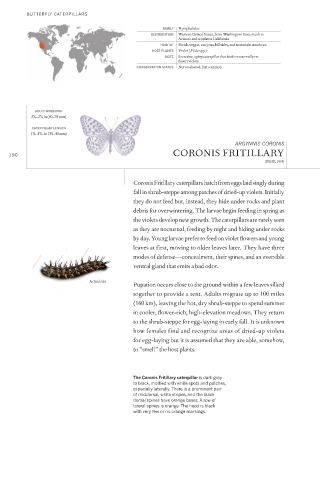
                                            The Coronis Fritillary caterpillar is dark gray
                                            to black, mottled with white spots and patches,
                                            especially laterally. There is a prominent pair
                                            of middorsal, white stripes, and the black
                                            dorsal spines have orange bases. A row of
                                            lateral spines is orange. The head is black
                                            with very few or no orange markings.

