


Page 197 - The Book of Caterpillars: A Life-Size Guide to Six Hundred Species From Around the World
P. 197
BUTTERFLY CATERPILLARS

                      FAMILY  Nymphalidae
                  DISTRIBUTION  The Himalayas, India, southern China, Chinese Taipei,
                           and most of Southeast Asia
                     HABITAT  Open forests and surrounding secondary growth
                  HOST PLANTS  Glochidion spp. and Phyllanthus spp. (both Phyllanthaceae);
                           also Wendlandia spp. (Rubiaceae)
                      NOTE  Caterpillar that uses perches and frass barriers to avoid predators
             CONSERVATION STATUS  Not evaluated, but common in its main range


                                                                                   ADULT WINGSPAN
                                                                                  2⅛–2 ⁄   in (55–65 mm)
                                                                                  CATERPILLAR LENGTH

                                                                                  1⅜–1 ⁄   in (35–40 mm)

            ATHYMA PERIUS
            COMMON SERGEANT                                                                      195
            (LINNAEUS, 1758)


            Early larval stages of the Common Sergeant isolate themselves
            from potential threats by constructing perches, where they rest
            between meals. By consuming the leaf lamina either side of
            the midrib of the leaf tip and building a barrier of frass woven
            together with silk at its entrance, the caterpillar can deter hungry
            ants and other predators. Although the maturing caterpillar
            is adorned with multiple branched spines, they are purely
            ornamental and non-stinging. When it does feel threatened,      Actual size
            the caterpillar adopts a defensive posture, arching the thorax

            and pressing the head  at against the leaf, presenting its spines
            as a physical barrier.
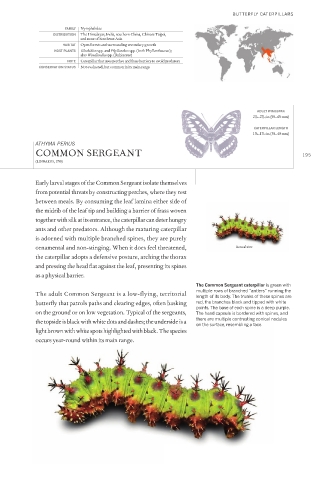
                                                                The Common Sergeant caterpillar is green with
            The adult Common Sergeant is a low-flying, territorial   multiple rows of branched “antlers” running the
                                                                length of its body. The trunks of these spines are
            butter y that patrols paths and clearing edges, often basking   red, the branches black and tipped with white

            on the ground or on low vegetation. Typical of the sergeants,   points. The base of each spine is a deep purple.
                                                                The head capsule is bordered with spines, and
            the topside is black with white dots and dashes; the underside is a   there are multiple contrasting conical nodules
                                                                on the surface, resembling a face.
            light brown with white spots highlighted with black. The species
            occurs year-round within its main range.

