


Page 188 - The Book of Caterpillars: A Life-Size Guide to Six Hundred Species From Around the World
P. 188
BUTTERFLY CATERPILLARS

                                                     FAMILY  Nymphalidae
                                                   TRIBUTION
                                                 DIS
                                                 DISTRIBUTION  From southern England and western France east across Europe
                                                 DISTRIBUTION
                                                          and temperate Asia to China, Japan, and Korea
                                                    HABIT A T  Deciduous, broad-leaved woodlands
                                                    HABITAT
                                                    HABITAT
                                                  HOST PLANTS
                                                    T PLANT
                                                  HOST PLANTS S  Willow (Salix spp.) and poplar (Populus spp.)
                                                  HOS
                                                      NOTE
                                                      NO TE  Cryptic, sluglike caterpillar that has a pair of threatening horns
                                                      NOTE
                                             CONSERV A TION S T A TUS  Not evaluated, but vulnerable in some countries,
                                             CONSERVATION STATUS
                                             CONSERVATION STATUS
                                                          including England
            ADULT WINGSPAN
           2¾–3½ in (70–90 mm)
           CATERPILLAR LENGTH
           1¾–2⅛ in (45–55 mm)
                                                                                 APATURA IRIS
                                                              PURPLE EMPEROR
    186
                                                                                   (LINNAEUS, 1758)


                                            Purple Emperor caterpillars hatch from green eggs laid singly
                                            in late summer on the upper surfaces of host tree leaves.

                                            First instars lie perfectly camouflaged along the upper midrib
                                            of leaves and feed nocturnally. After reaching the second
                                            or third instar, the caterpillars enter hibernation resting on a
                                            silk pad spun on the upper surface of a withered leaf or twig,
                                            turning brown to blend in with their surroundings during the
                                            winter. Feeding resumes in spring, and the large, plump, green
                                            caterpillars pupate in June. The pupa, suspended from a leaf,
                                            is perfectly camouflaged, and the adult emerges after two weeks.


                                            The Purple Emperor is an iconic butterfly, especially in England,
                                            where its relatively few well-known breeding sites often become
                                            tourist attractions, with people craning their necks to spot the
                                            emperors flying in the treetops. Apatura iris is single-brooded,

                                            with adults on the wing in July and August. The caterpillars can
                                            be found from August to June.


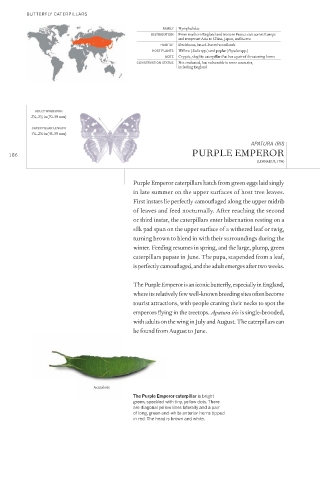
                               Actual size
                                            The Purple Emperor caterpillar is bright
                                            green, speckled with tiny, yellow dots. There
                                            are diagonal yellow lines laterally and a pair
                                            of long, green-and-white anterior horns tipped
                                            in red. The head is brown and white.

