


Page 191 - The Book of Caterpillars: A Life-Size Guide to Six Hundred Species From Around the World
P. 191
BUTTERFLY CATERPILLARS
FAMILY Nymphalidae
DIS
DISTRIBUTION Northern United States, southern Canada
TRIBUTION
DISTRIBUTION
HABIT A T Open boggy areas within cool, boreal spruce fir habitats
HABITAT
HABITAT
HOS
HOST PLANTS S Violet (Viola spp.)
T PLANT
HOST PLANTS
TE
NOTE Secretive, nocturnal, spiny caterpillar that is rarely seen
NO
NOTE
CONSERV A TION S T A TUS Not evaluated, but not common
CONSERVATION STATUS
CONSERVATION STATUS
ADULT WINGSPAN
2⅜–2⁄ in (60–65 mm)
CATERPILLAR LENGTH
1⅜–1⁄ in (35–40 mm)
ARGYNNIS ATLANTIS
ATLANTIS FRITILLARY 189
(W. H. EDWARDS, 1862)
Atlantis Fritillary caterpillars hatch from eggs laid singly in
late summer and early fall on or near dried-up violets. They
immediately overwinter under debris and rocks, without
feeding, and only start to feed when violets produce growth in
spring. The larvae, which are solitary with no nests, take about
two months to reach the pupal stage. Most feeding occurs at
night, and the caterpillars rest under leaves by day. Later instars
have an eversible ventral “neck” gland that produces a musky
odor when they are disturbed. The odor is thought to repel
predators such as ground beetles and ants.
Pupae are formed in silked-together “leaf-tents” close to the
ground. Adults fly during June to August, and males emerge
before females. The males feed on mud and animal scat, as well as
flowers such as thistles and yarrow. The species is closely related
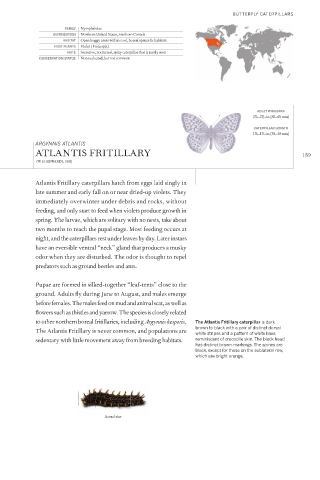
to other northern boreal fritillaries, including Argynnis hesperis. The Atlantis Fritillary caterpillar is dark
The Atlantis Fritillary is never common, and populations are brown to black with a pair of distinct dorsal
white stripes and a pattern of white lines
sedentary with little movement away from breeding habitats. reminiscent of crocodile skin. The black head
has distinct brown markings. The spines are
black, except for those on the sublateral row,
which are bright orange.
Actual size

