


Page 190 - The Book of Caterpillars: A Life-Size Guide to Six Hundred Species From Around the World
P. 190
BUTTERFLY CATERPILLARS
FAMILY Nymphalidae
DISTRIBUTION North Africa, Europe, Turkey, and across temperate Asia to
China and Japan
HABITAT Open woodlands with glades and rides, woodland margins,
bracken-covered slopes, and subalpine meadows
HOST PLANTS Violet (Viola spp.)
NOTE Striking spiny caterpillar that basks in the sun
CONSERVATION STATUS Not evaluated, but locally vulnerable
ADULT WINGSPAN
2⅛–2⁄ in (55–69 mm)
CATERPILLAR LENGTH
1½–1⅝ in (38–42mm)
ARGYNNIS ADIPPE
HIGH BROWN FRITILLARY
188
([DENIS & SCHIFFERMÜLLER], 1775)
The female High Brown Fritillary butterfly lays her pale
pink eggs singly on dead leaves and stems either on or near
the food plant. The eggs overwinter, becoming gray as the
larvae develop within, and hatch in spring. The caterpillars
feed along the edge of Viola leaves, leaving characteristic cutouts
along the leaf margin. They are active during the day and can
often be spotted basking in the sun. The caterpillars pupate on
their host plant, suspended below a twig or leaf by a silk pad, and
take on the appearance of a shriveled leaf.
The adult butterflies are on the wing in summer, with a single
generation annually. In parts of its range, especially the United
Kingdom, the species has declined significantly, mostly as a
result of the shift away from traditional woodland management
in which glades and rides were opened up to allow more light to
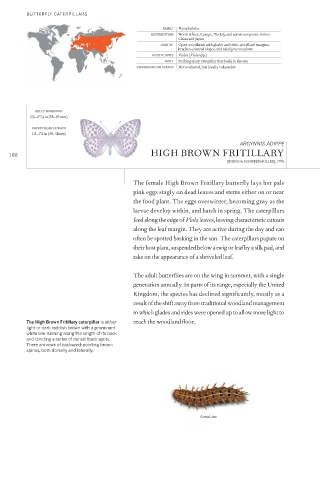
The High Brown Fritillary caterpillar is either reach the woodland floor.
light or dark reddish brown with a prominent
white line running along the length of its back
and dividing a series of dorsal black spots.
There are rows of backward-pointing brown
spines, both dorsally and laterally.
Actual size

