


Page 194 - The Book of Caterpillars: A Life-Size Guide to Six Hundred Species From Around the World
P. 194
BUTTERFLY CATERPILLARS

                                                     FAMILY  Nymphalidae
                                                 DISTRIBUTION  Western North America, from Alaska and Manitoba
                                                          to Arizona and Colorado
                                                    HABITAT  Moist alpine and subalpine meadows, watercourses,
                                                          and roadsides
                                                  HOST PLANTS  Violet (Viola spp.)
                                                      NOTE  Variably colored, nocturnal, spiny caterpillar that is
                                                          associated with violets
                                             CONSERVATION STATUS  Not evaluated, but common


            ADULT WINGSPAN
           1¾–2 in (44–50 mm)
           CATERPILLAR LENGTH


           1 ⁄  –1⅜ in (30–35 mm)
                                                                          ARGYNNIS MORMONIA
                                                        MORMON FRITILLARY
    192
                                                                                  (BOISDUVAL, 1869)


                                            Female Mormon Fritillaries crawl on the ground seeking out
                                            suitable oviposition sites among violets, where they lay their eggs
                                            singly. The eggs hatch after ten days, and  rst instar caterpillars

                                            seek refuge under leaves and rocks for overwintering. For
                                            optimum survival they require humid conditions. In spring,
                                            the larvae start feeding on violets as plant growth commences.
                                            The caterpillar’s defense is based on spines, chemical protection
                                            from the bad odor produced by a ventral “neck” gland, and
                                            concealment. The coloration and markings of the larvae are

                                            in uenced by geography and elevation.

                                            Development to pupation takes about two months. Mature
                                            caterpillars silk leaves together as “pupation tents,” and pupation
                                            occurs close to the ground; pre-pupae that fall to the ground are
                                            able to pupate successfully. Adults, produced after a further two

                                            or three weeks,  y from June to September. Dispersal of adults is

                                            limited, and males patrol for females. Both sexes feed on  ower
                                            nectar, but males will also feed on animal scat, mud, and carrion.


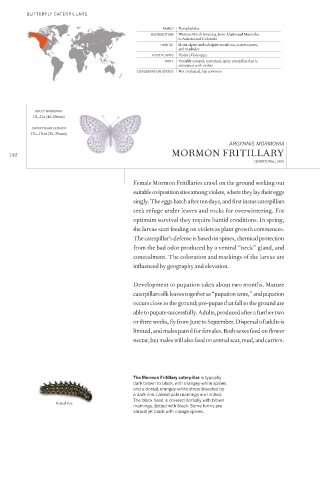
                                            The Mormon Fritillary caterpillar is typically
                                            dark brown to black, with orangey-white spines
                                            and a dorsal, orangey-white stripe bisected by
                                            a dark line. Lateral pale markings are limited.
                                            The black head is covered dorsally with brown
                   Actual size
                                            markings, dotted with black. Some forms are
                                            almost jet black with orange spines.

