


Page 199 - The Book of Caterpillars: A Life-Size Guide to Six Hundred Species From Around the World
P. 199
BUTTERFLY CATERPILLARS

                      FAMILY  Nymphalidae
                  DIS
                    TRIBUTION
                  DISTRIBUTION  North America, from Alaska and western Canada to
                  DISTRIBUTION
                           Washington State and Montana
                     HABITAT
                     HABITAT
                     HABIT A T  Arctic-alpine and high Arctic rockslides, ridges, and tundra
                  HOST PLANTS
                  HOST PLANTS
                  HOS T PLANT S  Saxifrage (Saxifraga spp.)
                      NOTE
                      NO TE  High-alpine caterpillar that takes two years to reach maturity
                      NOTE
                   TION S
                  A
                      T
                       A
                       TUS
             CONSERVATION STATUS
             CONSERV
             CONSERVATION STATUS  Not evaluated, but rare in parts of its range
                                                                                   ADULT WINGSPAN
                                                                                  2–2⅛ in (50–55 mm)
                                                                                  CATERPILLAR LENGTH


                                                                                   1–1⅜ (25–35 mm)
            BOLORIA ASTARTE
            ASTARTE FRITILLARY                                                                   197
            (DOUBLEDAY & HEWITSON, 1847)
            The eggs of the Astarte Fritillary are laid singly on or near the
            host plant in midsummer. First instars hatch after eight days and
            do not consume their eggshells. Some development takes place


            in the  rst year, with caterpillars overwintering as  rst or second
            instars. Feeding then recommences in spring, and the caterpillar

            reaches the fourth or  fth instar by the end of the short summer.
            The mature caterpillar overwinters and pupates on or near the
            host plant in the following June. Adults emerge from late July
            to early August.


            Astarte Fritillary caterpillars use camou age, concealment, and
            chemicals produced from a ventral gland to defend themselves.
            The species, a true alpine specialist, generally occurring above
            8,200 ft (2,500 m), may be vulnerable to climate warming or
            may adapt to longer summers. There is some evidence that the    Actual size
            caterpillars can complete development in a single season if they
            are exposed to warm conditions.


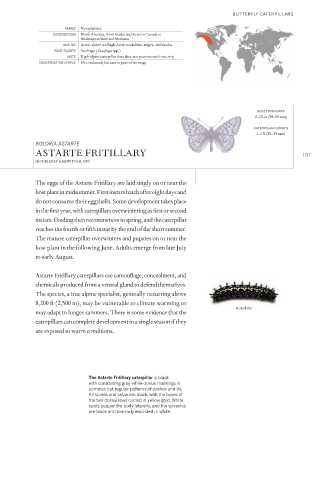
                             The Astarte Fritillary caterpillar is black
                             with contrasting gray-white dorsal markings in
                             complex but regular patterns of dashes and Vs.
                             All spines and setae are black, with the bases of
                             the two dorsal rows circled in yellow gold. White
                             spots pepper the body laterally, and the spiracles
                             are black and narrowly encircled in white.

