


Page 200 - The Book of Caterpillars: A Life-Size Guide to Six Hundred Species From Around the World
P. 200
BUTTERFLY CATERPILLARS

                                                     FAMILY  Nymphalidae
                                                 DISTRIBUTION
                                                 DIS TRIBUTION  Across Europe and northern Asia to Russian Far East
                                                 DISTRIBUTION
                                                    HABITAT
                                                    HABITAT T  Woodland clearings, margins, and tracks; and recently
                                                    HABIT
                                                       A
                                                          coppiced wood with open ground and bracken
                                                  HOS
                                                    T PLANT
                                                  HOST PLANTS S  Violet (Viola spp.)
                                                  HOST PLANTS
                                                      NO
                                                      NOTE  Dark, bristly caterpillar that feeds during the day
                                                       TE
                                                      NOTE
                                             CONSERVATION STATUS  Not evaluated, but endangered in parts of its range
                                             CONSERVATION STATUS
                                             CONSERV
                                                  TION S
                                                      TUS
                                                      A
                                                     T
                                                 A
            ADULT WINGSPAN
           1½–1⅞ in (38–47 mm)
           CATERPILLAR LENGTH
             1 in (25 mm)                                                 BOLORIA EUPHROSYNE
                                                             PEARL-BORDERED
                                                                        FRITILLARY
    198
                                                                                   (LINNAEUS, 1758)
                                            Caterpillars of the Pearl-bordered Fritillary hatch from pale
                                            yellow eggs laid singly either on the host plant or on the
                                            surrounding leaf litter, especially bracken (Pteridium aquilinum).
                                            The larvae are active by day, feeding around the base of violet
                                            leaves and creating a characteristic pattern of leaf damage that
                      Actual size
                                            gives away their presence. They molt three times and then
                                            overwinter in a dry, rolled-up leaf. Feeding resumes early
                                            in spring, before the caterpillars pupate in the leaf litter.


                                            The adult butter ies, which get their name from the white, pearl-
                                            like spots on the underside of the hindwing, are active from April
                                            to June, while a second generation may be seen in August. The
                                            species is under threat from the loss of suitable habitat and
                                            the decline in traditional woodland management, especially
                                            coppicing, which creates the open, sunny conditions needed

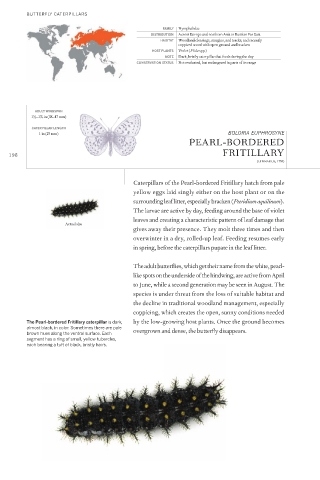
          The Pearl-bordered Fritillary caterpillar is dark,   by the low-growing host plants. Once the ground becomes
          almost black, in color. Sometimes there are pale   overgrown and dense, the butter y disappears.

          brown hues along the ventral surface. Each
          segment has a ring of small, yellow tubercles,
          each bearing a tuft of black, bristly hairs.

