


Page 201 - The Book of Caterpillars: A Life-Size Guide to Six Hundred Species From Around the World
P. 201
BUTTERFLY CATERPILLARS

                      FAMILY  Nymphalidae
                  DISTRIBUTION  Throughout much of northern North America, Asia, and Europe
                     HABITAT  Bogs, fens, and riparian habitats at mid-elevations
                  HOST PLANTS  Violet (Viola spp.)
                      NOTE  Spiny, cryptically colored, nocturnal caterpillar that is associated
                           with violets
             CONSERVATION STATUS  Not evaluated, but threatened in some locations due to
                           declining habitat


                                                                                   ADULT WINGSPAN
                                                                                  1¾–2 in (45–50 mm)
                                                                                  CATERPILLAR LENGTH
            BOLORIA SELENE                                                        1–1 ⁄   in (25–30 mm)
            SILVER-BORDERED
            FRITILLARY                                                                           199

            (DENIS & SCHIFFERMÜLLER, 1775)


            Silver-bordered Fritillary caterpillars hatch within five to
            six days from eggs laid on violets. In late summer, the larvae
            enter dormancy and overwinter as second to fourth instars.
            Early instars feed on the undersides of violet leaves, while later
            instars eat large holes from the leaf edge inward. Their survival   Actual size
            is based on three means of protection—concealment, spines, and
            a ventral gland that produces a musky odor to deter predators.

            There are  ve instars, and no nests are made. Development from
             rst instar to pupation takes about 30 days, with adults emerging

            after a further 10 to 14 days.


            There are one to three generations per season, depending on
            location. Adult males patrol conspicuously over grassy, boggy
            areas near violets, looking for females. After mating, females
            remain concealed in the vegetation. Grazing by deer or livestock
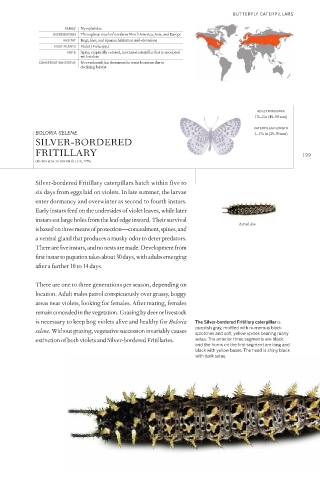
            is necessary to keep bog violets alive and healthy for Boloria   The Silver-bordered Fritillary caterpillar is
            selene. Without grazing, vegetative succession invariably causes   purplish gray, mottled with numerous black
                                                               splotches and soft, yellow spines bearing many
            extinction of both violets and Silver-bordered Fritillaries.  setae. The anterior three segments are black,
                                                               and the horns on the   rst segment are long and
                                                               black with yellow bases. The head is shiny black
                                                               with dark setae.

