


Page 202 - The Book of Caterpillars: A Life-Size Guide to Six Hundred Species From Around the World
P. 202
BUTTERFLY CATERPILLARS

                                                     FAMILY  Nymphalidae
                                                 DISTRIBUTION  Across Europe and southern Scandinavia into southern Russia,
                                                          central Asia, and northern China
                                                    HABITAT  Damp mountain meadows at 1,970–5,900 ft (600–1,800 m)
                                                          elevation near to woodland
                                                  HOST PLANTS  Polygonum bistorta and violet (Viola spp.)
                                                      NOTE  Spiky, black caterpillar that is found in damp alpine meadows
                                             CONSERVATION STATUS  Not evaluated, but classed as near threatened in Europe


            ADULT WINGSPAN
           1½–1⅞ in (38–48 mm)
           CATERPILLAR LENGTH
             ⁄  –⅞ in (18–22 mm)
                                                                              BOLORIA TITANIA
                                                       TITANIA’S FRITILLARY
    200
                                                                                     (ESPER, 1793)


                                            Titania’s Fritillary caterpillars hatch from eggs laid singly by
                                            the female on host plants or on nearby vegetation. The young
                                            caterpillars do not eat but go into diapause, overwintering on
                                            the host plant. In spring, the larvae, which are solitary, become
                                            active again and start to feed. They pupate on plants close to the
                                            host plant, where they remain for three weeks. The pupa is well
                                            camou aged, with the appearance of a shriveled leaf.


                                            There is a single generation annually. The fast- ying butter ies


                                            are on the wing from late June to August. Though still quite
                                            common in the Alps at higher altitudes, the species is in decline
                                            as a result of habitat loss, especially its favored meadows close
                                            to forests. Today there are scattered and relatively isolated
                                            colonies, which may account for the numerous subspecies that
                                            occur across the range. The species was formerly classified
                                            within the genus Clossiana, and many texts still refer to it
                                            as Clossiana titania.


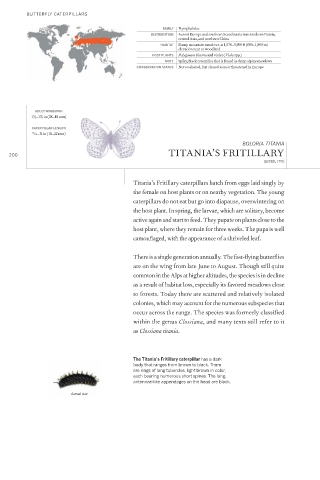
                                            The Titania’s Fritillary caterpillar has a dark
                                            body that ranges from brown to black. There
                                            are rings of long tubercles, light brown in color,
                                            each bearing numerous short spines. The long,
                                            antennae-like appendages on the head are black.
                        Actual size

