


Page 204 - The Book of Caterpillars: A Life-Size Guide to Six Hundred Species From Around the World
P. 204
BUTTERFLY CATERPILLARS

                                                     FAMILY  Nymphalidae
                                                 DIS
                                                 DISTRIBUTION  Hispaniola (Dominican Republic and Haiti)
                                                   TRIBUTION
                                                 DISTRIBUTION
                                                    HABIT A T  Dry scrub, acacia-cactus woodlands, and pine forests
                                                    HABITAT
                                                    HABITAT
                                                  HOST PLANTS
                                                  HOST PLANTS S  Grasses, including Poa spp. and Stenophrum spp.
                                                    T PLANT
                                                  HOS
                                                      NO
                                                       TE
                                                      NOTE  Green-brown caterpillar that closely resembles related species
                                                      NOTE
                                             CONSERVATION STATUS  Not evaluated
                                                  TION S
                                             CONSERV
                                             CONSERVATION STATUS
                                                      A
                                                 A
                                                     T
                                                      TUS
            ADULT WINGSPAN
            ½–⅝ in (12–16 mm)
           CATERPILLAR LENGTH
             ¾ in (20 mm)
                                                                             CALISTO OBSCURA
                                                             CALISTO OBSCURA
    202
                                                                                   MICHENER, 1943
                                            Calisto obscura caterpillars hatch from eggs laid on grasses. They

                                            are extremely well camou aged on their host grasses and di cult


                                            to  nd, with the life cycle taking around 73 days to complete.


                                            The butter y adults are on the wing in all seasons and possibly
                                            produce two generations a year. Calisto obscura is found across
                                            Hispaniola, occurring in a wide range of habitats, from sandy,
                                            coastal grassland to highland pine forest, and including very
                                            dry habitats, such as acacia-cactus woodlands.


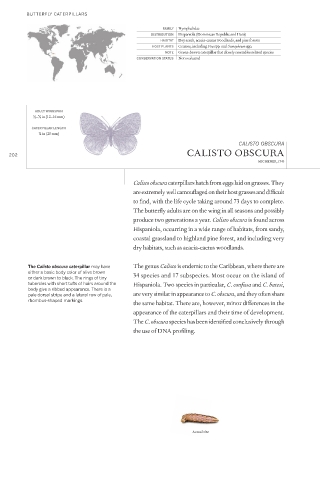
          The Calisto obscura caterpillar may have   The genus Calisto is endemic to the Caribbean, where there are
          either a basic body color of olive brown   34 species and 17 subspecies. Most occur on the island of
          or dark brown to black. The rings of tiny
          tubercles with short tufts of hairs around the   Hispaniola. Two species in particular, C. confusa and C. batesi,
          body give a ribbed appearance. There is a
          pale dorsal stripe and a lateral row of pale,   are very similar in appearance to C. obscura, and they often share
          rhombus-shaped markings.          the same habitat. There are, however, minor di erences in the

                                            appearance of the caterpillars and their time of development.
                                            The C. obscura species has been identi ed conclusively through

                                            the use of DNA pro ling.


                                                              Actual size

