


Page 203 - The Book of Caterpillars: A Life-Size Guide to Six Hundred Species From Around the World
P. 203
BUTTERFLY CATERPILLARS

                      FAMILY  Nymphalidae
                  DISTRIBUTION  From northern Spain across central and southern Europe;
                           also Russia, Turkmenistan, Mongolia, northern China, Korea,
                           and Japan
                     HABITAT  Woodland clearings and scrub
                  HOST PLANTS  Filipendula spp. and Rubus spp.
                      NOTE  Striking caterpillar that feeds mostly on bramble species
             CONSERVATION STATUS  Not evaluated, but increasingly rare in some areas


                                                                                   ADULT WINGSPAN

                                                                                 1⅓
–1 ⁄   in (26–40 mm)

                                                                                  CATERPILLAR LENGTH


                                                                                    1⅜ in (35 mm)
            BRENTHIS DAPHNE
            MARBLED FRITILLARY                                                                   201
            BERGSTRÄSSER, 1780


            The female Marbled Fritillary lays her ridged, conical-shaped,
            yellow-brown eggs singly on leaves and sometimes the  owers

            of the host plants. The embryonic larvae overwinter within
            the eggs and hatch the following spring. The caterpillars feed
            and then complete their development quickly over just a few

            weeks, before they pupate. The lea ike pupa, which has a ridge
            of spikes, is found hanging under stems and twigs.


            There is a single generation annually. The adult butter ies are
            seen throughout the summer in warm woodland clearings and
            sunny slopes at altitudes of 245–5,750 ft (75–1,750 m). The
            species is declining in many areas due to loss of its scrubby
            woodland habitat, which is often cleared for agriculture and
            vineyards. It is one of four species within the genus Brenthis
            and is frequently confused with the Lesser Marbled Fritillary
            (B. ino), which is on the wing at the same time.


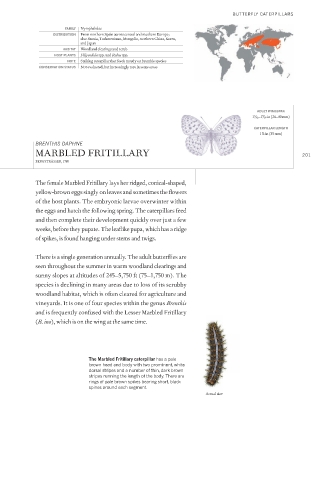
                             The Marbled Fritillary caterpillar has a pale
                             brown head and body with two prominent, white
                             dorsal stripes and a number of thin, dark brown
                             stripes running the length of the body. There are
                             rings of pale brown spikes bearing short, black
                             spines around each segment.
                                                                   Actual size

