


Page 25 - The Book of Caterpillars: A Life-Size Guide to Six Hundred Species From Around the World
P. 25
VORACIOUS EATERS


            plants. Where hosts contain toxic chemicals, caterpillars have evolved to

            neutralize them and even use them as a defense against predators.
            Caterpillars can overcome a plant’s physical barriers, too, such as hairs or
            sticky, toxic latex. Monarch larvae (Danaus plexippus), for instance, cut
            milkweed leaf veins or the petiole to prevent the flow of latex into leaf parts.

               Ants, aphids, or scale insects provide a diet for carnivorous caterpillars,
            such as Moth Butterfly larvae (Liphyra brassolis), which enter the nests of
            the Green Tree Ant (Oecophylla smaragdina) and devour the ant larvae.
            Some caterpillars feed on dung and others feed on fungi, shells, feathers,
            or fibers—the preferred host material of the insatiable Case-bearing

            Clothes Moth larva (Tinea pellionella), a pest of worldwide renown.
               Unpalatable or well-defended caterpillars feeding in groups do not hide            23
            and are usually “messy” feeders, leaving large areas of damaged leaves.
            Palatable caterpillars usually conceal evidence of feeding, consuming

            entire leaves or severing half-eaten leaves and letting them drop from the
            plant. Others feed within plants, such as the Subflexa Straw Moth caterpillar
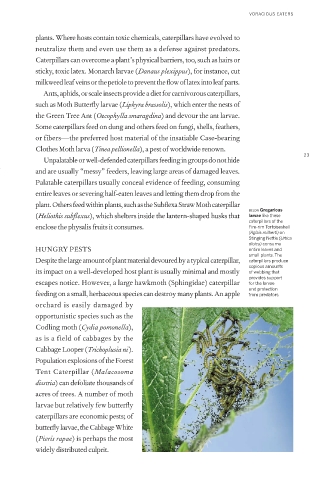
                                                                                below Gregarious
            (Heliothis subflexus), which shelters inside the lantern-shaped husks that   larvae like these
                                                                                caterpillars of the
            enclose the physalis fruits it consumes.                            Fire-rim Tortoiseshell
                                                                                (Aglais milberti) on
                                                                                Stinging Nettle (Urtica
                                                                                dioica) consume
            HUNGRY PESTS                                                        entire leaves and
                                                                                small plants. The
            Despite the large amount of plant material devoured by a typical caterpillar,   caterpillars produce
                                                                                copious amounts
            its impact on a well-developed host plant is usually minimal and mostly   of webbing that
            escapes notice. However, a large hawkmoth (Sphingidae) caterpillar   provides support
                                                                                for the larvae
            feeding on a small, herbaceous species can destroy many plants. An apple   and protection
                                                                                from predators.
            orchard is easily damaged by
            opportunistic species such as the
            Codling moth (Cydia pomonella),
            as is a field of cabbages by the
            Cabbage Looper (Trichoplusia ni).

            Population explosions of the Forest
            Tent Caterpillar (Malacosoma
            disstria) can defoliate thousands of
            acres of trees. A number of moth

            larvae but relatively few butterfly
            caterpillars are economic pests; of
            butterfly larvae, the Cabbage White
            (Pieris rapae) is perhaps the most
            widely distributed culprit.

