


Page 24 - The Book of Caterpillars: A Life-Size Guide to Six Hundred Species From Around the World
P. 24
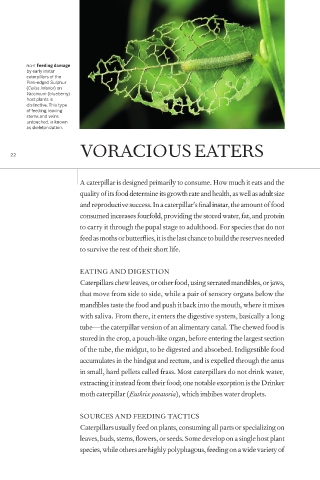
right Feeding damage
          by early instar
          caterpillars of the
          Pink-edged Sulphur
          (Colias interior) on
          Vaccinium (blueberry)
          host plants is
          distinctive. This type
          of feeding, leaving
          stems and veins
          untouched, is known
          as skeletonization.
                           VORACIOUS EATERS

    22
    22


                           A caterpillar is designed primarily to consume. How much it eats and the

                           quality of its food determine its growth rate and health, as well as adult size
                           and reproductive success. In a caterpillar’s final instar, the amount of food
                           consumed increases fourfold, providing the stored water, fat, and protein
                           to carry it through the pupal stage to adulthood. For species that do not
                           feed as moths or butterflies, it is the last chance to build the reserves needed
                           to survive the rest of their short life.


                           EATING AND DIGESTION
                           Caterpillars chew leaves, or other food, using serrated mandibles, or jaws,
                           that move from side to side, while a pair of sensory organs below the

                           mandibles taste the food and push it back into the mouth, where it mixes
                           with saliva. From there, it enters the digestive system, basically a long
                           tube—the caterpillar version of an alimentary canal. The chewed food is
                           stored in the crop, a pouch-like organ, before entering the largest section
                           of the tube, the midgut, to be digested and absorbed. Indigestible food

                           accumulates in the hindgut and rectum, and is expelled through the anus
                           in small, hard pellets called frass. Most caterpillars do not drink water,
                           extracting it instead from their food; one notable exception is the Drinker
                           moth caterpillar (Euthrix potatoria), which imbibes water droplets.


                           SOURCES AND FEEDING TACTICS
                           Caterpillars usually feed on plants, consuming all parts or specializing on
                           leaves, buds, stems, flowers, or seeds. Some develop on a single host plant
                           species, while others are highly polyphagous, feeding on a wide variety of

