


Page 205 - The Book of Caterpillars: A Life-Size Guide to Six Hundred Species From Around the World
P. 205
BUTTERFLY CATERPILLARS


                      FAMILY  Nymphalidae
                  DISTRIBUTION  Central America, from Honduras to Panama; South America,
                           south to Peru, Bolivia, and southern Brazil
                     HABITAT  Humid, mid-elevation subtropical to temperate cloud forests
                  HOST PLANTS  Alchornea spp.
                      NOTE  Caterpillar with metallic highlights that make it resemble
                           sparkling dew
             CONSERVATION STATUS  Not evaluated, but unlikely to become endangered


                                                                                   ADULT WINGSPAN
                                                                                  2¾–3¾ in (70–95 mm)
                                                                                  CATERPILLAR LENGTH
                                                                                  2 ⁄  –3 in (65–75 mm)
            CATONEPHELE CHROMIS
            SISTER-SPOTTED BANNER                                                                203

            (DOUBLEDAY, [1848])


            The eggs of the Sister-spotted Banner are laid singly on fresh
            leaves of the host plant, and young larvae build a frass chain on
            which to rest. Older larvae rest on the upper surface of the leaf
            with their long head horns pressed tightly to the leaf, waving
            them wildly back and forth over their body if disturbed. Such


            a defense is presumably e ective at deterring the parasitic  ies
            and wasps that commonly attack this species in some parts of


            its range. After the  fth,  nal instar, larvae pupate on the dorsal
            surface of a leaf, the emerald-green chrysalis resembling a leafy
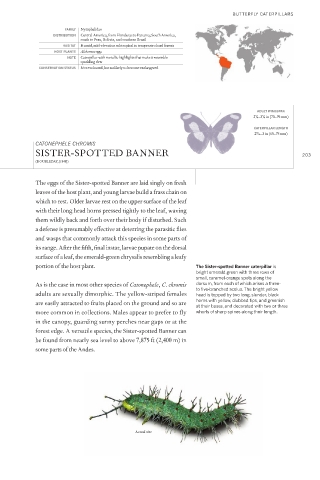
            portion of the host plant.                          The Sister-spotted Banner caterpillar is
                                                                bright emerald green with three rows of
                                                                small, caramel-orange spots along the
            As is the case in most other species of Catonephele, C. chromis   dorsum, from each of which arises a three-
            adults are sexually dimorphic. The yellow-striped females   to   ve-branched scolus. The bright yellow
                                                                head is topped by two long, slender, black
            are easily attracted to fruits placed on the ground and so are   horns with yellow, clubbed tips, and greenish
                                                                at their bases, and decorated with two or three
            more common in collections. Males appear to prefer to fly   whorls of sharp spines along their length.
            in the canopy, guarding sunny perches near gaps or at the
            forest edge. A versatile species, the Sister-spotted Banner can
            be found from nearly sea level to above 7,875 ft (2,400 m) in
            some parts of the Andes.


                                            Actual size

