


Page 206 - The Book of Caterpillars: A Life-Size Guide to Six Hundred Species From Around the World
P. 206
BUTTERFLY CATERPILLARS

                                                     FAMILY  Nymphalidae
                                                 DISTRIBUTION  North America (except northern Canada and the southwest
                                                          United States), south to northern Mexico
                                                    HABITAT  Prairies, meadows, roadsides, parks, and forest openings
                                                  HOST PLANTS  Grasses, including Festuca spp., Poa spp., and Avena spp.

                                                      NOTE  Superbly camou aged caterpillar that feeds on grass
                                             CONSERVATION STATUS  Not evaluated, but common


            ADULT WINGSPAN
           1¾–2 in (45–50 mm)
           CATERPILLAR LENGTH
           1–1 ⁄   in (25–30 mm)
                                                                            CERCYONIS PEGALA
                                                   COMMON WOOD NYMPH
    204
                                                                                   (FABRICIUS, 1775)


                                            Common Wood Nymph caterpillars hatch from eggs laid singly
                                            nine to ten days earlier on grasses or nearby surfaces, and often
                                            tucked deep into a clump. The young caterpillars overwinter in
                                            dormancy and do not start feeding until the following spring,
                                            when grasses produce new growth. The larvae feed mostly
                                            at night on grass-blade edges, often spending the day at the
                                            base of the grass. No nests are made, and survival is based on


                                            camou age. There are  ve or six instars, and pupation usually
                                            occurs on host grasses, with pupae suspended from a bent-over
                                            stem or blade, sometimes encircled by silk strands.


                                            Development in spring to adulthood takes two to three months.

                                            A single brood of adults  ies from May to September, becoming
                                            dormant during the heat of summer in many areas. During this
                                            time, females may be found in groups of 6 to 20, resting in the

                                            shade, neither feeding nor egg-laying. Both sexes feed on  ower

                                            nectar and sap  ows.


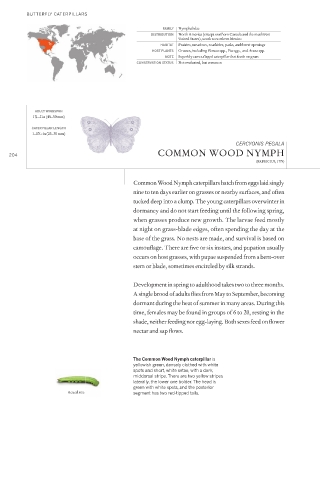
                                            The Common Wood Nymph caterpillar is
                                            yellowish green, densely clothed with white
                                            spots and short, white setae, with a dark,
                                            middorsal stripe. There are two yellow stripes
                                            laterally, the lower one bolder. The head is
                                            green with white spots, and the posterior
                       Actual size          segment has two red-tipped tails.

