


Page 207 - The Book of Caterpillars: A Life-Size Guide to Six Hundred Species From Around the World
P. 207
BUTTERFLY CATERPILLARS

                      FAMILY  Nymphalidae
                  DIS TRIBUTION  Java to Timor and northern Australia
                  DISTRIBUTION
                  DISTRIBUTION
                     HABITAT
                     HABIT A T  Monsoon forests, especially along streams
                     HABITAT
                  HOST PLANTS
                  HOST PLANTS
                  HOS T PLANT S  Lacewing Vine (Adenia heterophylla)
                        TE
                      NOTE  Brightly colored, gregarious caterpillar
                      NO
                      NOTE
                  A
             CONSERVATION STATUS  Not evaluated, but of no immediate conservation concern
             CONSERVATION STATUS
             CONSERV
                       TUS
                   TION S
                       A
                      T
                                                                                   ADULT WINGSPAN
                                                                                    2⅝ in (66 mm)
                                                                                  CATERPILLAR LENGTH
                                                                                    1¼ in (32 mm)
            CETHOSIA PENTHESILEA
            ORANGE LACEWING                                                                      205
            (CRAMER, 1777)

            Orange Lacewing caterpillars hatch from clusters of eggs
            usually laid on the tendrils of the food plant vine or on the upper
            surface of leaves. The caterpillars are gregarious and consume
            large amounts of leaf material and green stems; in captivity they
            will also consume fruit and woody stems. The larvae pupate
            together, suspended head down by the cremaster. They can be
            found throughout the year, although adult butter ies are most

            numerous early in the dry season (April to July).


            The caterpillars have aposematic coloration and are distasteful
            to predators, as are many species in this subfamily of butter ies

            (Heliconiinae). Although most members of the subfamily occur
            in the Amazon basin of South America, the genus Cethosia has
            12 species that range from India to Australia. The Orange
            Lacewing is often displayed in butterfly houses in Australia
            because of its ease of rearing and attractive coloration, and the

             ight behavior of the adults.


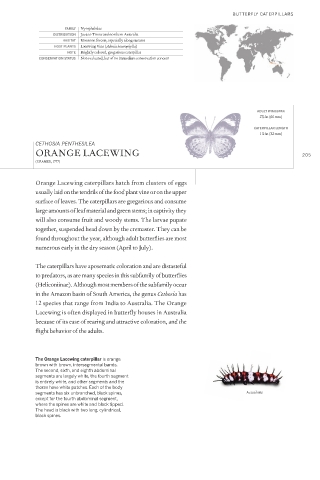
            The Orange Lacewing caterpillar is orange
            brown with brown, intersegmental bands.
            The second, sixth, and eighth abdominal
            segments are largely white, the fourth segment
            is entirely white, and other segments and the
            thorax have white patches. Each of the body
            segments has six unbranched, black spines,                          Actual size
            except for the fourth abdominal segment,
            where the spines are white and black tipped.
            The head is black with two long, cylindrical,
            black spines.

