


Page 208 - The Book of Caterpillars: A Life-Size Guide to Six Hundred Species From Around the World
P. 208
BUTTERFLY CATERPILLARS

                                                     FAMILY  Nymphalidae
                                                 DISTRIBUTION  Across much of Africa and southern Europe
                                                    HABITAT  Dry grasslands, maquis, lightly wooded hillsides, parks,
                                                          and gardens
                                                  HOST PLANTS  Various, including Strawberry Tree (Arbutus unedo),
                                                          Sorghum roxburghii, Lonchocarpus cyanescens, and Cassine spp.
                                                      NOTE  Bizarre-looking, “dinosaur-head” caterpillar with four
                                                          backward-pointing spines
                                             CONSERVATION STATUS  Not evaluated


            ADULT WINGSPAN
           2 ⁄  –3 in (65–75 mm)
           CATERPILLAR LENGTH
            Up to 2 in (50 mm)
                                                                              CHARAXES JASIUS
                                                          TWO-TAILED PASHA
    206
                                                                                   (LINNAEUS, 1767)


                                            Two-tailed Pasha caterpillars hatch from large eggs laid by the

                                            female butter y on the upper surface of leaves of the host plant;
                                            she usually lays just one egg per leaf. Emerging, each caterpillar
                                            spins its own leaf tent of silken threads in which it shelters when
                                            not feeding. The caterpillars pupate away from the host plant,
                                            either in the leaf litter or suspended from a twig by a silken

                                            pad. The pupae are well camou aged as they resemble small,
                                            ripening fruits. There are two generations a year, one in early

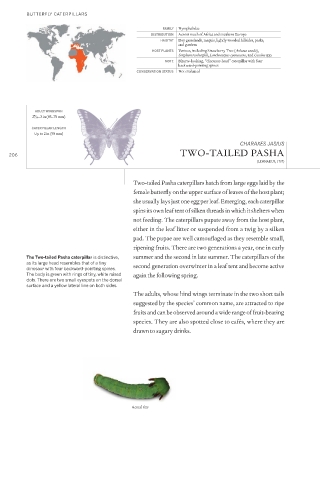
         The Two-tailed Pasha caterpillar is distinctive,   summer and the second in late summer. The caterpillars of the
         as its large head resembles that of a tiny   second generation overwinter in a leaf tent and become active
         dinosaur with four backward-pointing spines.
         The body is green with rings of tiny, white raised   again the following spring.
         dots. There are two small eyespots on the dorsal
         surface and a yellow lateral line on both sides.
                                            The adults, whose hind wings terminate in the two short tails
                                            suggested by the species’ common name, are attracted to ripe
                                            fruits and can be observed around a wide range of fruit-bearing
                                            species. They are also spotted close to cafés, where they are
                                            drawn to sugary drinks.


                                           Actual size

