


Page 26 - The Book of Caterpillars: A Life-Size Guide to Six Hundred Species From Around the World
P. 26
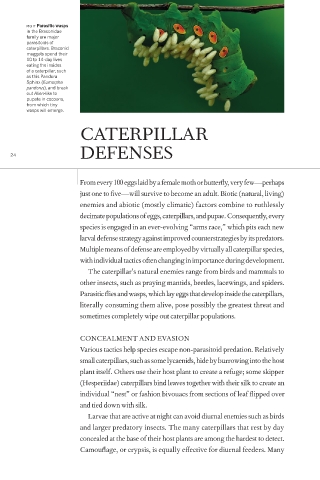
right Parasitic wasps
          in the Braconidae
          family are major
          parasitoids of
          caterpillars. Braconid
          maggots spend their
          10 to 14-day lives
          eating the insides
          of a caterpillar, such
          as this Pandora
          Sphinx (Eumorpha
          pandorus), and break
          out Alien-like to
          pupate in cocoons,
          from which tiny
          wasps will emerge.
                           CATERPILLAR


                           DEFENSES
    24
    24


                           From every 100 eggs laid by a female moth or butterfly, very few—perhaps

                           just one to five—will survive to become an adult. Biotic (natural, living)
                           enemies and abiotic (mostly climatic) factors combine to ruthlessly
                           decimate populations of eggs, caterpillars, and pupae. Consequently, every
                           species is engaged in an ever-evolving “arms race,” which pits each new
                           larval defense strategy against improved counterstrategies by its predators.
                           Multiple means of defense are employed by virtually all caterpillar species,

                           with individual tactics often changing in importance during development.
                             The caterpillar’s natural enemies range from birds and mammals to
                           other insects, such as praying mantids, beetles, lacewings, and spiders.
                           Parasitic flies and wasps, which lay eggs that develop inside the caterpillars,

                           literally consuming them alive, pose possibly the greatest threat and
                           sometimes completely wipe out caterpillar populations.


                           CONCEALMENT AND EVASION
                           Various tactics help species escape non-parasitoid predation. Relatively

                           small caterpillars, such as some lycaenids, hide by burrowing into the host
                           plant itself. Others use their host plant to create a refuge; some skipper
                           (Hesperiidae) caterpillars bind leaves together with their silk to create an
                           individual “nest” or fashion bivouacs from sections of leaf flipped over

                           and tied down with silk.
                             Larvae that are active at night can avoid diurnal enemies such as birds
                           and larger predatory insects. The many caterpillars that rest by day
                           concealed at the base of their host plants are among the hardest to detect.
                           Camouflage, or crypsis, is equally effective for diurnal feeders. Many

