


Page 218 - The Book of Caterpillars: A Life-Size Guide to Six Hundred Species From Around the World
P. 218
BUTTERFLY CATERPILLARS

                                                     FAMILY  Nymphalidae
                                                 DISTRIBUTION  Africa, southern Europe, India, Sri Lanka, China, and areas
                                                          of Southeast Asia
                                                    HABITAT  Open country, deserts, grasslands, and gardens up to
                                                          8,200 ft (2,500 m) elevation
                                                  HOST PLANTS  Milkweed (Asclepias spp.)
                                                      NOTE  Monarch-like caterpillar that has extra tentacles
                                             CONSERVATION STATUS  Not evaluated, but common


            ADULT WINGSPAN
           2⅛–2⅜ in (55–60 mm)
           CATERPILLAR LENGTH


           1 ⁄  –1⅜ in (30–35 mm)
                                                                           DANAUS CHRYSIPPUS
                                                                       PLAIN TIGER
    216
                                                                                   (LINNAEUS, 1758)


                                            The female Plain Tiger perches on the upper side of a leaf
                                            and, curling its abdomen around the edge, lays an egg on the
                                            underside. Only one egg is laid per leaf to avoid overcrowding.

                                            After the caterpillar hatches, its  rst meal is the eggshell. It lives
                                            its entire life on the lower side of the leaves. Larvae defend
                                            themselves against some predators by sequestering poisons from

                                            their host plants. However, at least one parasitic wasp is speci c
                                            to this species and can be responsible for up to 85 percent of

                                            mortality in an a ected population.

                                            Plain Tigers are usually encountered singly or in twos and
                                            threes. They have a slow, undulating flight, and both sexes
                                            patrol flowery areas, taking nectar. An alternative name
                                            for the species is African Monarch, and it is closely related
                                            to the well-known North American Monarch (Danaus
                                            plexippus). The caterpillars of the two species are very similar,
                                            but the Plain Tiger has an extra pair of tentacles, which it uses

                                            to try to avoid being parasitized by  ies and wasps.


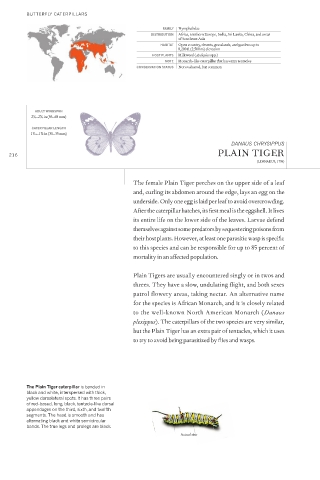
          The Plain Tiger caterpillar is banded in
          black and white, interspersed with thick,
          yellow dorsolateral spots. It has three pairs
          of red-based, long, black, tentacle-like dorsal
          appendages on the third, sixth, and twelfth
          segments. The head is smooth and has
          alternating black and white semicircular
          bands. The true legs and prolegs are black.
                                                           Actual size

