


Page 220 - The Book of Caterpillars: A Life-Size Guide to Six Hundred Species From Around the World
P. 220
BUTTERFLY CATERPILLARS

                                                     FAMILY  Nymphalidae
                                                 DISTRIBUTION  Southern Canada, United States, Bermuda, Mexico,
                                                          the Canary Islands, Australia, and New Zealand
                                                    HABITAT  Almost any open habitat, especially riparian areas
                                                  HOST PLANTS  Milkweed (Asclepias spp.)

                                                      NOTE  Colorful caterpillar of arguably the world’s best-known butter y
                                             CONSERVATION STATUS  Not evaluated, but numbers in steep decline in North America


            ADULT WINGSPAN
           3½–4 in (90–100 mm)
           CATERPILLAR LENGTH
             2⅛ in (55 mm )
                                                                            DANAUS PLEXIPPUS
                                                                           MONARCH
    218
                                                                                   (LINNAEUS, 1758)


                                            The Monarch caterpillar hatches from cream-colored eggs laid
                                            singly on the underside of young milkweed leaves. Feeding
                                            only on milkweeds, Monarch caterpillars, like other related
                                            milkweed-feeding species, advertise their distastefulness by
                                            their striking, banded coloration. The unpalatability of adults
                                            and larvae to birds and other predators is due to stored cardiac
                                            glycosides, or heart toxins, that are obtained from their host
                                            plant. The caterpillar develops rapidly through five instars,
                                            then forms a bright green, gold-spotted pupa, suspended
                                            from a silken pad. The complete life cycle from egg to adult
                                            takes only around 30 days.


                                            Eastern North American Monarchs migrate up to 3,000 miles
                                            (4,800 km) from Canada to high-elevation forests in Mexico
                                            for overwintering. The species belongs to a family of about 300

                                            milkweed butter ies that generally remain within tropical and
                                            subtropical regions. Numbers have declined in the past 20 years
                                            as a result of habitat destruction and a depletion of milkweeds.


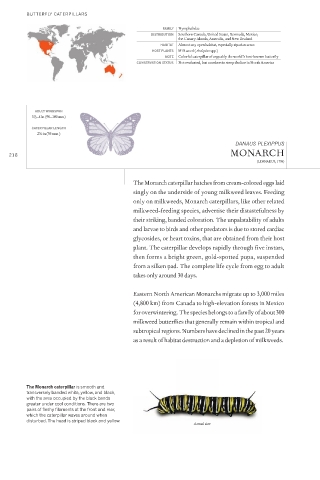
         The Monarch caterpillar is smooth and
         transversely banded white, yellow, and black,
         with the area occupied by the black bands
         greater under cool conditions. There are two
         pairs of   eshy   laments at the front and rear,
         which the caterpillar waves around when
         disturbed. The head is striped black and yellow.
                                                               Actual size

