


Page 219 - The Book of Caterpillars: A Life-Size Guide to Six Hundred Species From Around the World
P. 219
BUTTERFLY CATERPILLARS

                      FAMILY  Nymphalidae
                  DISTRIBUTION  Southern United States, south to Argentina
                     HABITAT  Warm areas everywhere, except dense forest
                  HOST PLANTS  Milkweed and milkweed vine (Asclepias spp., Sarcostemma spp.,
                           Cynanchum spp., and Matelea spp.)
                      NOTE  Caterpillar and adult that are unpalatable to birds
             CONSERVATION STATUS  Not evaluated, but most common in tropical parts of its range


                                                                                   ADULT WINGSPAN
                                                                                  2⅝–3⅞ in (67–98 mm)
                                                                                  CATERPILLAR LENGTH
                                                                                    2⅛ in (55 mm)
            DANAUS GILIPPUS
            QUEEN                                                                                217

            (CRAMER, 1775)


            Queen caterpillars eat plants in the milkweed family, ingesting
            the cardiac glycoside poisons they contain, which makes both
            larvae and adults poisonous to predating birds. Queen and
            related Monarch (Danaus plexippus) caterpillars are often found
            on the same milkweed plants. The larvae of both species chew
            through the midrib of leaves before feeding on them, in order to

            reduce the  ow of the poisonous milky sap into the leaf they eat.
            The Queen caterpillar goes through six instars before it pupates,
            and the adult emerges within seven to ten days.


            The principal difference between Queen and Monarch


            caterpillars is that Queens have three pairs of  eshy  laments
            (tentacles) while Monarchs have only two. Like Monarchs,
            Queens migrate north in spring and south in fall, but their
            migrations are much smaller and they remain common in
            Florida and Mexico during the summer. As the Queen uses the

            same pheromones as the African Milkweed Butter y (Danaus
            chrysippus), the two could potentially mate if artificially
            introduced, though hybrids might be infertile.


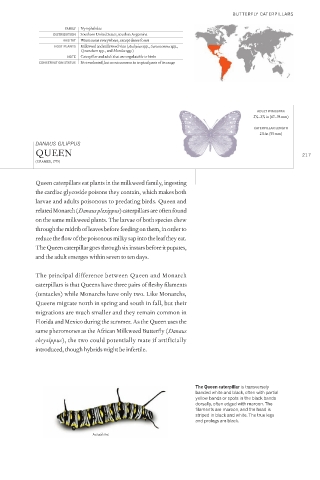
                                                               The Queen caterpillar is transversely
                                                               banded white and black, often with partial
                                                               yellow bands or spots in the black bands
                                                               dorsally, often edged with maroon. The
                                                                 laments are maroon, and the head is
                                                               striped in black and white. The true legs
                                                               and prolegs are black.

                              Actual size

