


Page 221 - The Book of Caterpillars: A Life-Size Guide to Six Hundred Species From Around the World
P. 221
BUTTERFLY CATERPILLARS

                      FAMILY  Nymphalidae
                  DISTRIBUTION  Guatemala, south to Bolivia, Paraguay, and southern Brazil
                     HABITAT  Humid lowland and foothill forest borders and mature
                           second growth
                  HOST PLANTS  Various species of Ulmaceae, especially Trema spp.
                      NOTE  Caterpillar that, when young, is protected by its frass chain
             CONSERVATION STATUS  Not evaluated, but not considered threatened


                                                                                   ADULT WINGSPAN
                                                                                  1½–1¾ in (38–45 mm)
                                                                                  CATERPILLAR LENGTH
            DIAETHRIA CLYMENA                                                     1⅜–1¾ in (35–45 mm)


            WIDESPREAD
            EIGHTY-EIGHT                                                                         219
            (CRAMER, 1775)


            Caterpillars of the Widespread Eighty-eight hatch from pale
            green eggs shaped like truncated cones and laid singly on
            the very margin of host plant leaves. Immediately, the tiny
            larvae begin building a frass chain close to the oviposition site,
            resting in safety at its tip while not feeding. By the third instar,
            they abandon this perch and rest on the dorsal surface of the
            leaf with their now-sizeable head scoli pressed  at to the leaf

            surface. When disturbed, older caterpillars rear backward and
            lift their hind prolegs, clashing together the terminal scoli with
            those on the head.


            The caterpillars move away from the host plant to pupate,
            forming a green chrysalis, attached to a leaf or stem. The
            adults are rapid fliers and frequently visit mud puddles and
            rotting fruit or dung. The species is so-named because of the
            undeniable similarity its underwing markings bear to the number
            88 (sometimes more like 89).


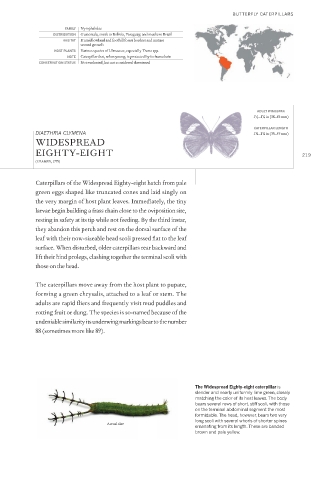
                                                               The Widespread Eighty-eight caterpillar is
                                                               slender and nearly uniformly lime green, closely
                                                               matching the color of its host leaves. The body
                                                               bears several rows of short, sti   scoli, with those
                                                               on the terminal abdominal segment the most
                                                               formidable. The head, however, bears two very
                                                               long scoli with several whorls of shorter spines
                                   Actual size
                                                               emanating from its length. These are banded
                                                               brown and pale yellow.

