


Page 243 - The Book of Caterpillars: A Life-Size Guide to Six Hundred Species From Around the World
P. 243
BUTTERFLY CATERPILLARS

                      FAMILY  Nymphalidae
                  DISTRIBUTION  North America, from southwestern and southeastern Canada
                           to northern Mexico
                     HABITAT  Disturbed open, weedy habitats, including roadsides,

                           watercourses, and  elds

                  HOST PLANTS  Plantain (Musa spp.),  gwort (Scrophularia spp.),
                           penstemon (Penstemon spp.), acanthus (Acanthus spp.),
                           and verbena (Verbena spp.)
                      NOTE  Colorful, spiny caterpillar that is prone to oral regurgitation
             CONSERVATION STATUS  Not evaluated, but common


                                                                                   ADULT WINGSPAN
                                                                                  2⅛–2⅜ in (55–60 mm)
                                                                                  CATERPILLAR LENGTH
                                                                                  1½–1 ⁄   in (38–40 mm)
            JUNONIA COENIA
            COMMON BUCKEYE                                                                       241

            HÜBNER, 1822


            Female Common Buckeye butterflies lay eggs singly on
            lower surfaces of host plant leaves or on terminal shoots. The
            caterpillars hatch within three days and consume the eggshells
            before feeding on leaves. All of the food plants used by this
            species contain iridoid glycosides, which encourage the larvae to   Actual size
            feed as well as supplying them with defensive compounds. First
            to third instars feed on the upper surface of leaves, producing
            clear patches or spots. Older instars feed openly, consuming
            leaves from the edges. During the day, the larvae often wander
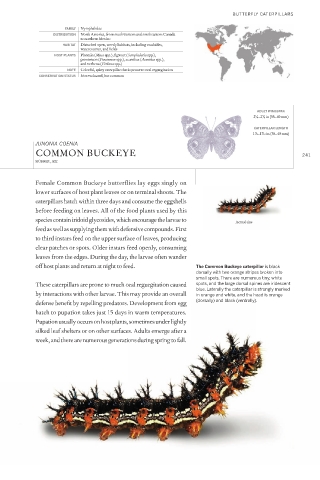
            o  host plants and return at night to feed.         The Common Buckeye caterpillar is black

                                                                dorsally with two orange stripes broken into
                                                                small spots. There are numerous tiny, white
            These caterpillars are prone to much oral regurgitation caused   spots, and the large dorsal spines are iridescent
            by interactions with other larvae. This may provide an overall   blue. Laterally the caterpillar is strongly marked
                                                                in orange and white, and the head is orange
            defense bene t by repelling predators. Development from egg   (dorsally) and black (ventrally).

            hatch to pupation takes just 15 days in warm temperatures.
            Pupation usually occurs on host plants, sometimes under lightly
            silked leaf shelters or on other surfaces. Adults emerge after a
            week, and there are numerous generations during spring to fall.

