


Page 244 - The Book of Caterpillars: A Life-Size Guide to Six Hundred Species From Around the World
P. 244
BUTTERFLY CATERPILLARS

                                                     FAMILY  Nymphalidae
                                                 DISTRIBUTION  Australia, mainland New Guinea, New Zealand, and islands of

                                                          the southwest Paci c
                                                    HABITAT  From woodlands to grasslands and urban gardens
                                                  HOST PLANTS  Herbaceous plants from several families, including Acanthaceae,
                                                          Asteraceae, Convolvulaceae, Gentianaceae, Goodeniaceae,
                                                          and Plantaginaceae
                                                      NOTE  Black caterpillar with branched spines that has numerous
                                                          food plants
                                             CONSERVATION STATUS  Not evaluated, but common and widespread in many habitats


            ADULT WINGSPAN
          1 ⁄  –1  ⁄   in (40–43 mm)
           CATERPILLAR LENGTH
           1 ⁄  –1 ⁄   in (37–40 mm)
                                                                              JUNONIA VILLIDA
                                                                MEADOW ARGUS
    242
                                                                                   (FABRICIUS, 1787)


                                            The Meadow Argus caterpillar is found singly and feeds
                                            during the day and at night. When not feeding, it rests under
                                            litter at the base of the plant. In the hot tropical conditions of
                                            the wet season, the caterpillar completes growth in two weeks,
                                            but breeding during the winter dry season appears to be limited.
                                            Several generations are completed annually in tropical areas, but
                                            perhaps only two in temperate regions. In cooler areas, when
                                            adults are not present, it is uncertain how overwintering occurs.


                                            The caterpillars often leave their food plant to pupate; attached
                                            by the cremaster to a silken pad, they hang head down on a rock
                                            or fence. Sporadic migration of the adult butter ies occurs but

                                            not in all locations or in all years. Caterpillars developing in the
                                            cool, short days of winter produce small adults preadapted to
                                            spring migration. The genus contains 30 to 35 species, commonly
                                            called “buckeyes,” which occur throughout the world.


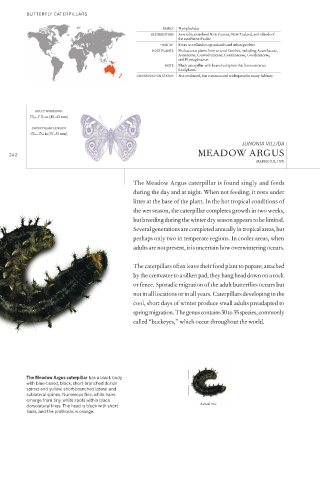
         The Meadow Argus caterpillar has a black body
         with blue-based, black, short-branched dorsal
         spines and yellow, short-branched lateral and
         sublateral spines. Numerous   ne, white hairs
         emerge from tiny, white spots within black
         dorsolateral lines. The head is black with short        Actual size
         hairs, and the prothorax is orange.

