


Page 245 - The Book of Caterpillars: A Life-Size Guide to Six Hundred Species From Around the World
P. 245
BUTTERFLY CATERPILLARS

                      FAMILY  Nymphalidae
                  DISTRIBUTION
                    TRIBUTION
                  DISTRIBUTION  Temperate and tropical Asia, as far north as southeast Siberia
                  DIS
                     HABIT A T  Forests, usually at higher elevations
                     HABITAT
                     HABITAT
                  HOST PLANTS S  Smilax spp. and Heterosmilax spp.
                    T PLANT
                  HOST PLANTS
                  HOS


                      NOTE
                      NO TE  Fierce-looking caterpillar that becomes a  erce-acting butter y
                      NOTE
             CONSERV A TION S T A TUS  Not evaluated, but locally common
             CONSERVATION STATUS
             CONSERVATION STATUS
                                                                                   ADULT WINGSPAN
                                                                                  2⅜–2¾ in (60–70 mm)
                                                                                  CATERPILLAR LENGTH
                                                                                    1 ⁄   in (40 mm)
            KANISKA CANACE
            BLUE ADMIRAL                                                                         243
            (LINNAEUS, 1763)


            The eggs of the Blue Admiral are laid on the leaves of host
            plants singly, enabling a wider distribution of the progeny.

            The larvae feed and develop through  ve instars over 23 days.
            In the later stages, the caterpillars rest on the undersides of
            leaves, adopting a characteristic U-shape when they are not
            feeding or when they are disturbed. Despite having a formidable
            set of spines, the caterpillar is harmless. When mature, it pupates
            in a spiky, ocherous chrysalis on the host plant stem or adjacent
            branches, and the adult ecloses after 12 days. There can be
            multiple generations throughout the year.


            The Blue Admiral, a powerful and acrobatic  yer, is insanely
            territorial and spends most of its time patrolling a de ned area


            chasing o  other butter ies—and even challenging people by

             apping in their faces. Kaniska canace is the only species of its

            genus, but there are numerous subspecies, some of which are

            colored di erently in their larval stages.


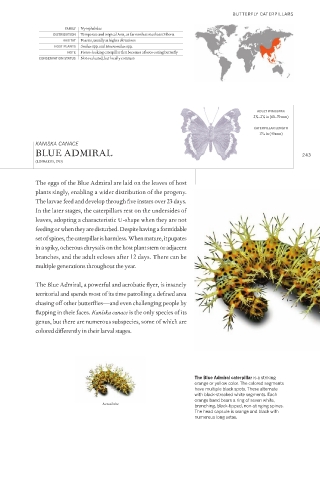
                                                               The Blue Admiral caterpillar is a striking
                                                               orange or yellow color. The colored segments
                                                               have multiple black spots. These alternate
                                                               with black-streaked white segments. Each
                                                               orange band bears a ring of seven white,
                                  Actual size                  branching, black-tipped, non-stinging spines.
                                                               The head capsule is orange and black with
                                                               numerous long setae.

