


Page 246 - The Book of Caterpillars: A Life-Size Guide to Six Hundred Species From Around the World
P. 246
BUTTERFLY CATERPILLARS

                                                     FAMILY  Nymphalidae
                                                 DISTRIBUTION  Southeastern Colombia, through the Andes to Bolivia and
                                                          northern Argentina
                                                    HABITAT  Montane forest edges, stream banks, and landslides
                                                  HOST PLANTS  Bamboo (Chusquea spp.)
                                                      NOTE  Caterpillar that mimics twiggy portions of its host plant
                                             CONSERVATION STATUS  Not evaluated, but not considered threatened


            ADULT WINGSPAN
           2 ⁄  –2
⁄   in (52–58 mm)
           CATERPILLAR LENGTH
           2–2⅜ in (50–60 mm)
                                                                          LASIOPHILA ORBIFERA
                                                                       FIERY SATYR
    244
                                                                                     BUTLER, 1868


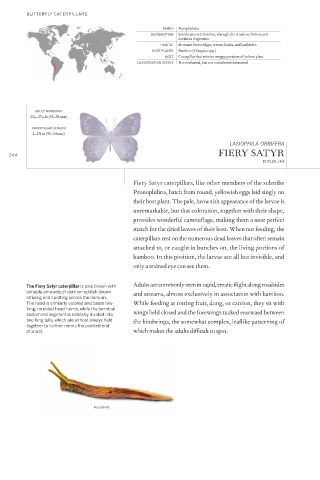
                                            Fiery Satyr caterpillars, like other members of the subtribe
                                            Pronophilina, hatch from round, yellowish eggs laid singly on
                                            their host plant. The pale, brownish appearance of the larvae is
                                            unremarkable, but that coloration, together with their shape,

                                            provides wonderful camou age, making them a near perfect
                                            match for the dried leaves of their host. When not feeding, the
                                            caterpillars rest on the numerous dead leaves that often remain
                                            attached to, or caught in bunches on, the living portions of
                                            bamboo. In this position, the larvae are all but invisible, and
                                            only a trained eye can see them.


                                            Adults are commonly seen in rapid, erratic  ight along roadsides
         The Fiery Satyr caterpillar is pale brown with
         variable amounts of dark or reddish-brown   and streams, almost exclusively in association with bamboo.
         striping and spotting across the dorsum.
         The head is similarly colored and bears two   While feeding at rotting fruit, dung, or carrion, they sit with
         long, rounded head horns, while the terminal   wings held closed and the forewings tucked rearward between
         abdominal segment is similarly divided into
         two long tails, which are almost always held   the hindwings, the somewhat complex, lea  ike patterning of
         together to further mimic the pointed end


         of a leaf.                         which makes the adults di cult to spot.


                               Actual size

