


Page 248 - The Book of Caterpillars: A Life-Size Guide to Six Hundred Species From Around the World
P. 248
BUTTERFLY CATERPILLARS

                                                     FAMILY  Nymphalidae
                                                 DISTRIBUTION  North America, from southern Canada to northern Mexico
                                                    HABITAT  Low-elevation riparian habitats, usually along watercourses
                                                  HOST PLANTS  Willow (Salix spp.), poplar (Populus spp.), plum (Prunus spp.),
                                                          and apple (Malus spp.)
                                                      NOTE  Horned caterpillar that has “bird dropping” markings
                                             CONSERVATION STATUS  Not evaluated, but locally common


            ADULT WINGSPAN
           3–3⅛ in (75–80 mm)
           CATERPILLAR LENGTH


           1⅜–1½ in (35–38 mm)
                                                                          LIMENITIS ARCHIPPUS
                                                                             VICEROY
    246
                                                                                    (CRAMER, 1776)


                                            Female Viceroys lay eggs singly on the upper side tips or edges
                                            of host plant leaves. After six days, the caterpillars hatch and
                                            begin to feed, mostly at night. First instars feed at the tip of a
                                            leaf, leaving the midrib exposed. On this, the caterpillar spins
                                            a silk mat and rests there, adding frass pellets to the tip of the
                                            midrib to extend the pier. The larvae use piers until the third
                                            instar, likely to provide protection from predators, which may
                                            have an aversion to frass. For defense, older instars use crypsis
                                            and aggression—waving their spiked horns when disturbed.


                                            The third instar overwinters in a shelter constructed from
                                            host plant leaves. Pupation usually occurs on the host plant,
                                            and development from egg to adults takes as little as 40 days.
                                            The adult Viceroy is a mimic of the Monarch (Danaus plexippus),
                                            gaining protection from the latter’s distastefulness. Recent
                                            research indicates that, like Monarch caterpillars, Viceroy larvae
                                            also sequester toxins from their host plants for defense.


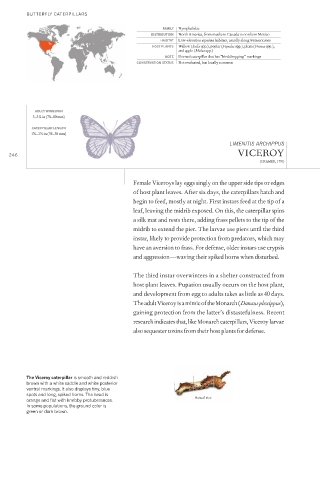
         The Viceroy caterpillar is smooth and reddish
         brown with a white saddle and white posterior
         ventral markings. It also displays tiny, blue
         spots and long, spiked horns. The head is
         orange and   at with knobby protuberances.            Actual size
         In some populations, the ground color is
         green or dark brown.

