


Page 247 - The Book of Caterpillars: A Life-Size Guide to Six Hundred Species From Around the World
P. 247
BUTTERFLY CATERPILLARS

                      FAMILY  Nymphalidae
                  DISTRIBUTION
                    TRIBUTION
                  DISTRIBUTION  Northeast India, southern China, and Southeast Asia
                  DIS
                     HABIT A T  Clearings and tracks in tropical forests
                     HABITAT
                     HABITAT
                  HOST PLANTS S  Cratoxylum formosum and Cratoxylum cochinchinense
                    T PLANT
                  HOS
                  HOST PLANTS
                      NO TE  Striking caterpillar that has lengthy protuberances bearing spines
                      NOTE
                      NOTE
             CONSERVATION STATUS
             CONSERV
                   TION S
                      T
                  A
                       TUS
                       A
             CONSERVATION STATUS  Not evaluated
                                                                                   ADULT WINGSPAN
                                                                                  3½–6 in (90–150 mm)
                                                                                  CATERPILLAR LENGTH
                                                                                    2 in (50 mm)
            LEXIAS PARDALIS
            COMMON ARCHDUKE                                                                      245
            (MOORE, 1878)
            On the underside of host plant leaves, the female Common
            Archduke lays green, dome-shaped eggs that are unusually
            pitted with honeycomb-shaped depressions and covered in tiny,

            hairlike spines. The caterpillars hatch and  rst consume their
            egghell before feeding on older and more mature leaves. Their
            unique appearance, with long protuberances bearing feather-

            like spines, provides excellent camou age against the foliage of
            its tropical forest habitat. As a defense, the larva also curls up,
            tucking its head under its spines. The mature caterpillar spins
            a silk mound on the underside of a leaf to which it attaches and
            then pupates. The pupa is smooth and green, with tapering ends,

            and is also well camou aged.
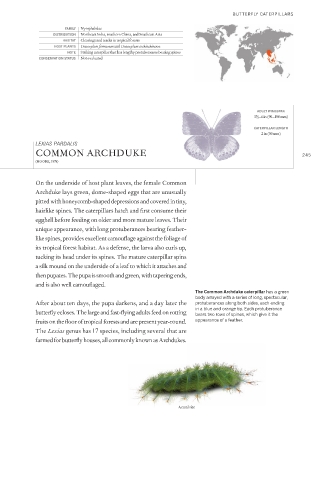
                                                               The Common Archduke caterpillar has a green
                                                               body arrayed with a series of long, spectacular,
            After about ten days, the pupa darkens, and a day later the   protuberances along both sides, each ending

            butter y ecloses. The large and fast- ying adults feed on rotting   in a blue and orange tip. Each protuberance

                                                               bears two rows of spines, which give it the
            fruits on the  oor of tropical forests and are present year-round.   appearance of a feather.

            The Lexias genus has 17 species, including several that are
            farmed for butter y houses, all commonly known as Archdukes.


                                                          Actual size

