


Page 249 - The Book of Caterpillars: A Life-Size Guide to Six Hundred Species From Around the World
P. 249
BUTTERFLY CATERPILLARS

                      FAMILY  Nymphalidae
                    TRIBUTION
                  DIS
                  DISTRIBUTION  Europe, across Asia to China and Japan
                  DISTRIBUTION
                     HABIT
                     HABITAT T  Deciduous forests and forest edges near streams
                     HABITAT
                        A
                  HOST PLANTS
                  HOS T PLANT S  Aspen (Populus tremula) and Black Poplar (Populus nigra)
                  HOST PLANTS

                        TE
                      NOTE  Well-camou aged caterpillar that feeds on young leaves
                      NOTE
                      NO
             CONSERV A TION S T A TUS  Not evaluated, but threatened in some parts of its range
             CONSERVATION STATUS
             CONSERVATION STATUS
                                                                                   ADULT WINGSPAN
                                                                                  2 ⁄  –3⅛ in (65–80 mm)
                                                                                  CATERPILLAR LENGTH
                                                                                    1 ⁄   in (30 mm)
            LIMENITIS POPULI
            POPLAR ADMIRAL                                                                       247
            (LINNAEUS, 1758)


            Female Poplar Admirals can be seen gliding around treetops
            before they lay their large eggs singly on leaves. After seven
            days, the caterpillars hatch and feed on leaf buds and young
            leaves. The larvae have a particular feeding pattern, consuming
            the leaf from its tip and avoiding the midrib on which they rest.
            By silking together frass pellets, the caterpillars may extend the
            midrib, a habit that is thought to deter ants and other predators.
            While still quite young, the larvae spin a loose cocoon within
            a rolled leaf in which they spend winter, emerging in spring to
            complete their growth and pupate on a leaf, webbing it so that
            the edges curl and protect the chrysalis.


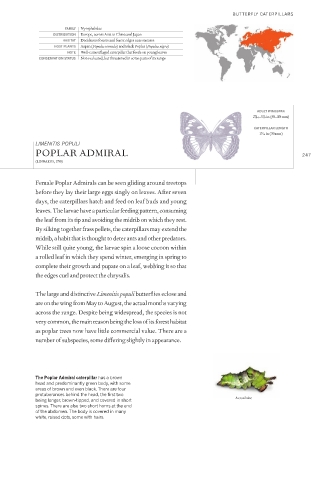
            The large and distinctive Limenitis populi butter ies eclose and
            are on the wing from May to August, the actual months varying
            across the range. Despite being widespread, the species is not
            very common, the main reason being the loss of its forest habitat
            as poplar trees now have little commercial value. There are a

            number of subspecies, some di ering slightly in appearance.


            The Poplar Admiral caterpillar has a brown
            head and predominantly green body, with some
            areas of brown and even black. There are four
            protuberances behind the head, the   rst two
            being longer, brown-tipped, and covered in short                Actual size
            spines. There are also two short horns at the end
            of the abdomen. The body is covered in many
            white, raised dots, some with hairs.

