


Page 250 - The Book of Caterpillars: A Life-Size Guide to Six Hundred Species From Around the World
P. 250
BUTTERFLY CATERPILLARS

                                                     FAMILY  Nymphalidae
                                                 DISTRIBUTION  Eastern Andean slopes, from Colombia to Bolivia
                                                    HABITAT  Interior of humid, montane cloud forests, generally at
                                                          3,950–8,900 ft (1,200-2,700 m) elevation
                                                  HOST PLANTS  Drymonia spp.
                                                      NOTE  Simply patterned caterpillars that have been reared few times
                                             CONSERVATION STATUS  Not evaluated, but not considered threatened


            ADULT WINGSPAN
           3⅜–3¾ in (85–95 mm)
           CATERPILLAR LENGTH
           1 ⁄  –2 in (40–50 mm)
                                                                          MEGOLERIA ORESTILLA
                                                     MEGOLERIA ORESTILLA
    248
                                                                                  (HEWITSON, 1867)


                                            Megoleria orestilla caterpillars hatch from yellowish-white,
                                            ribbed eggs, shaped like an elongated barrel, that are laid singly
                                            or in small groups of five to eight, usually on the underside
                                            of host plant leaves. The larvae hatch together and feed in a
                                            characteristic manner, tending to eat channels and small holes
                                            near the end of the leaf, causing it to droop, which helps conceal
                                            them. When fully developed, the caterpillar forms a mottled,
                                            pale green pupa, oddly bent in shape and suspended from a leaf.
                                            From oviposition to eclosion takes around 70 to 80 days.


                                            Although it is not known with certainty, these slow-moving
                                            caterpillars are likely chemically defended against attacks by
                                            vertebrate predators. Nevertheless, rearing projects in eastern
                                            Ecuador have found them to frequently fall prey to several types
                                            of parasitic wasps and flies. Like most other related species,
                                            adults of Megoleria orestilla are slow, floppy fliers—another
                                            indicator that they are likely chemically defended. The genus
                                            Megoleria belongs to the subfamily Ithomiinae of so-called
                                            clearwing butter ies.


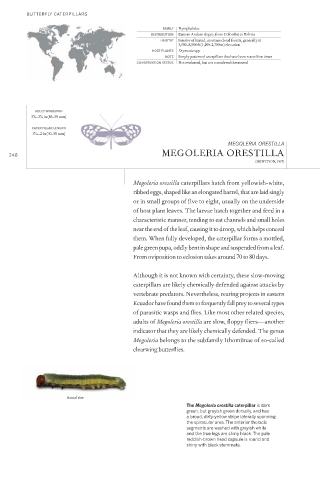
                      Actual size
                                                             The Megoleria orestilla caterpillar is dark
                                                             green, but grayish green dorsally, and has
                                                             a broad, dirty-yellow stripe laterally spanning
                                                             the spiracular area. The anterior thoracic
                                                             segments are washed with grayish white
                                                             and the true legs are shiny black. The pale
                                                             reddish-brown head capsule is round and
                                                             shiny with black stemmata.

