


Page 251 - The Book of Caterpillars: A Life-Size Guide to Six Hundred Species From Around the World
P. 251
BUTTERFLY CATERPILLARS

                      FAMILY  Nymphalidae
                  DISTRIBUTION  Most of Africa, South and Southeast Asia, extending to Australia
                           and New Zealand
                     HABITAT  Meadows and forest edges as well as disturbed habitat; also in rice
                            elds and among other grassy crops

                  HOST PLANTS  Grasses and bamboo, including Poa spp. and Oryza spp.
                      NOTE  Widely occurring caterpillar that can be a pest on rice
             CONSERVATION STATUS  Not evaluated, but common


                                                                                   ADULT WINGSPAN
                                                                                  2–3⅛ in (50–80 mm)
                                                                                  CATERPILLAR LENGTH
                                                                                  2–2¾ in (50–70 mm)
            MELANITIS LEDA
            COMMON EVENING BROWN                                                                 249

            (LINNAEUS, 1758)


            The Common Evening Brown caterpillar is typical of its
            subfamily Satyrinae, with cryptic coloration that matches the
            pattern and shape of the long grass blades it feeds on. While

            living on such an abundant resource o ers many advantages,
            it has shortcomings, too, as grasses are a tough, low-nutrient
            food. As a result, it usually takes a long time for the caterpillar
            to develop, and the ingested chemicals do not o er protection

            from predators or parasitoids. Hence the larvae have to rely on
            being undetected on the matching background.


            The Satyrinae subfamily of butter ies encompasses more than

            2,400 species, whose caterpillars—with a few exceptions—feed
            on monocot plants such as grasses and bamboos and are quite
            similar in appearance. Like some other satyrine butterflies,
            Melanitis leda adults have a distinct wet season form with
            numerous eyespots on their underside—thought to deflect
            attacks from predators—and various dry season forms that
            mimic diverse fallen leaf patterns.


                                                             Actual size
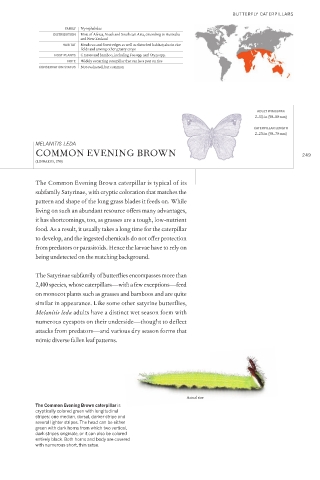
            The Common Evening Brown caterpillar is
            cryptically colored green with longitudinal
            stripes: one median, dorsal, darker stripe and
            several lighter stripes. The head can be either
            green with dark horns from which two vertical,
            dark stripes originate, or it can also be colored
            entirely black. Both horns and body are covered
            with numerous short, thin setae.

