


Page 252 - The Book of Caterpillars: A Life-Size Guide to Six Hundred Species From Around the World
P. 252
BUTTERFLY CATERPILLARS

                                                     FAMILY  Nymphalidae
                                                 DISTRIBUTION  North Africa, across Europe, Middle East, and northern Asia
                                                           (Russia and Mongolia)
                                                    HABITAT  Open grassland on thin, rocky soils, and subalpine meadows
                                                  HOST PLANTS  Ribwort Plantain (Plantago lanceolata) and speedwell
                                                          (Veronica spp.)
                                                      NOTE  Spiny, black caterpillar that lives in a silken web
                                             CONSERVATION STATUS  Not evaluated, but locally endangered


            ADULT WINGSPAN
           1½–1⅞ in (38–47 mm)
           CATERPILLAR LENGTH
             1 in (25 mm)
                                                                              MELITAEA CINXIA
                                                    GLANVILLE FRITILLARY
    250
                                                                                   (LINNAEUS, 1758)


                                            Glanville Fritillary caterpillars hatch from clusters of between
                                            50 and 200 yellow eggs laid on the underside of a leaf of the
                                            host plant. The caterpillars are gregarious, staying together
                                            within a silk web that they spin over the host plant and in
                                            which they feed. They are often spotted basking on the surface
                       Actual size
                                            on sunny days. The larvae spin a silk tent within tall grass, where
                                            they overwinter, becoming active again in spring. The mature

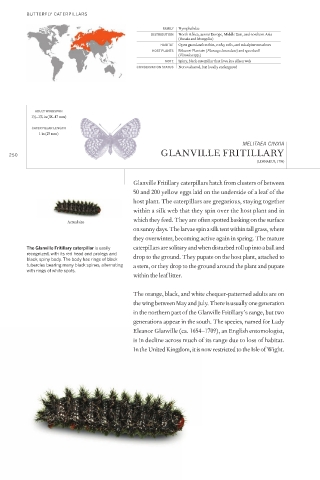
          The Glanville Fritillary caterpillar is easily   caterpillars are solitary and when disturbed roll up into a ball and
          recognized, with its red head and prolegs and   drop to the ground. They pupate on the host plant, attached to
          black, spiny body. The body has rings of black
          tubercles bearing many black spines, alternating   a stem, or they drop to the ground around the plant and pupate
          with rings of white spots.
                                            within the leaf litter.


                                            The orange, black, and white chequer-patterned adults are on
                                            the wing between May and July. There is usually one generation
                                            in the northern part of the Glanville Fritillary’s range, but two
                                            generations appear in the south. The species, named for Lady
                                            Eleanor Glanville (ca. 1654–1709), an English entomologist,
                                            is in decline across much of its range due to loss of habitat.
                                            In the United Kingdom, it is now restricted to the Isle of Wight.

