


Page 260 - The Book of Caterpillars: A Life-Size Guide to Six Hundred Species From Around the World
P. 260
BUTTERFLY CATERPILLARS

                                                     FAMILY  Nymphalidae
                                                 DISTRIBUTION  Central Europe, through central Asia and southern Russia
                                                          to Japan, and south to Southeast Asia
                                                    HABITAT  Damp, temperate woodlands and tropical rain forests
                                                          up to 3,950 ft (1,200 m) elevation
                                                  HOST PLANTS  Pea (Lathyrus spp.) and Black Locust (Robinia pseudacacia)
                                                      NOTE  Oddly shaped caterpillar that has disruptive coloring

                                                          for camou age
                                             CONSERVATION STATUS  Not evaluated, but common across its range


            ADULT WINGSPAN
           1 ⁄  –1⅞ in (40–48 mm)
           CATERPILLAR LENGTH
             1 in (25 mm)
                                                                               NEPTIS SAPPHO
                                                               COMMON GLIDER
    258
                                                                                    (PALLAS, 1771)


                                            Common Glider caterpillars hatch from round eggs laid by the
                                            female in shady places on the upper surface of leaves of the host
                                            plant. Each egg is covered with a network of hexagonally shaped
                                            ridges, which bear tiny hairs. The young caterpillars shelter
                                            within curled-up leaves and emerge to feed on the leaf, leaving
                                            the midrib, along which they rest. Their body has a disruptive
                                            outline, which provides excellent camouflage among dead
                                            leaves. The larvae overwinter and pupate the following spring.
                                            The pupa has the appearance of a dried-up leaf suspended
                                            from a stem.


                                            The Common Glider completes its development in just  ve to

                                            six weeks, so there are as many as four generations a year, and
                                            the adults  y from April to September. Also known as the Pallas


                                            Sailor, the species gets its common names from the butter y’s

                     Actual size            powerful gliding or sailing style of  ight.


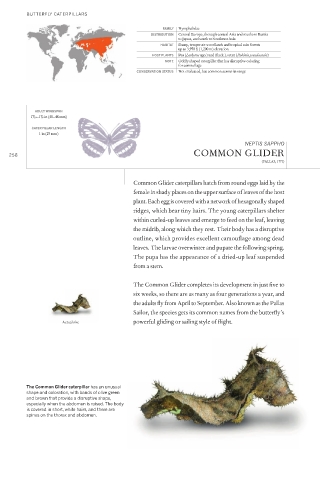
         The Common Glider caterpillar has an unusual
         shape and coloration, with bands of olive green
         and brown that provide a disruptive shape,
         especially when the abdomen is raised. The body
         is covered in short, white hairs, and there are
         spines on the thorax and abdomen.

