


Page 262 - The Book of Caterpillars: A Life-Size Guide to Six Hundred Species From Around the World
P. 262
BUTTERFLY CATERPILLARS

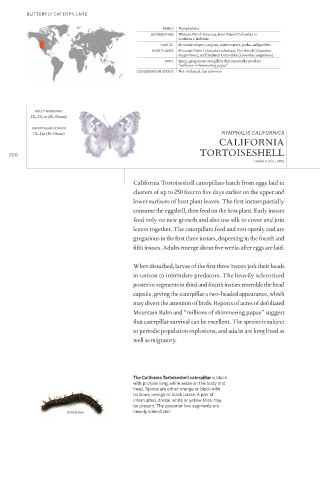
                                                     FAMILY  Nymphalidae
                                                 DISTRIBUTION  Western North America, from British Columbia to
                                                          southern California
                                                    HABITAT  Mountain slopes, canyons, watercourses, parks, and gardens
                                                  HOST PLANTS  Mountain Balm (Ceanothus velutinus), Deerbrush (Ceanothus
                                                          integerrimus), and Redstem Ceanothus (Ceanothus sanguineus)
                                                      NOTE  Spiny, gregarious caterpillars that reportedly produce
                                                          “millions of shimmering pupae”
                                             CONSERVATION STATUS  Not evaluated, but common


            ADULT WINGSPAN
           2⅜–2 ⁄   in (60–65 mm)
           CATERPILLAR LENGTH
           1¾–2 in (45–50 mm)                                           NYMPHALIS CALIFORNICA
                                                                       CALIFORNIA
                                                                 TORTOISESHELL
    260
                                                                                  (BOISDUVAL, 1852)


                                            California Tortoiseshell caterpillars hatch from eggs laid in

                                            clusters of up to 250 four to  ve days earlier on the upper and

                                            lower surfaces of host plant leaves. The  rst instars partially
                                            consume the eggshell, then feed on the host plant. Early instars
                                            feed only on new growth and also use silk to cover and join
                                            leaves together. The caterpillars feed and rest openly and are
                                            gregarious in the  rst three instars, dispersing in the fourth and


                                             fth instars. Adults emerge about  ve weeks after eggs are laid.

                                            When disturbed, larvae of the  rst three instars jerk their heads

                                            in unison to intimidate predators. The heavily sclerotized
                                            posterior segments in third and fourth instars resemble the head
                                            capsule, giving the caterpillar a two-headed appearance, which
                                            may divert the attention of birds. Reports of acres of defoliated
                                            Mountain Balm and “millions of shimmering pupae” suggest
                                            that caterpillar survival can be excellent. The species is subject
                                            to periodic population explosions, and adults are long lived as
                                            well as migratory.


                                            The California Tortoiseshell caterpillar is black
                                            with profuse long, white setae on the body and
                                            head. Spines are either orange or black with
                                            bulbous, orange or black bases. A pair of
                                            interrupted, dorsal, white or yellow lines may
                                            be present. The posterior two segments are
                      Actual size           heavily sclerotized.

