


Page 261 - The Book of Caterpillars: A Life-Size Guide to Six Hundred Species From Around the World
P. 261
BUTTERFLY CATERPILLARS

                      FAMILY  Nymphalidae
                  DISTRIBUTION  North America, Europe, and Asia
                     HABITAT  Riparian corridors, glades, groves, parks, and yards
                  HOST PLANTS  Many, including willow (Salix spp.), poplar (Populus spp.),
                           birch (Betula spp.), apple (Malus spp.), and alder (Alnus spp.)
                      NOTE  Spiny, gregarious caterpillar that is often seen on backyard willows
             CONSERVATION STATUS  Not evaluated, but common


                                                                                   ADULT WINGSPAN
                                                                                  3–3⅛ in (75–80 mm)
                                                                                  CATERPILLAR LENGTH
                                                                                  2–2⅛ in (50–55 mm)
            NYMPHALIS ANTIOPA
            MOURNING CLOAK                                                                       259

            (LINNAEUS, 1758)


            Female Mourning Cloak butter ies lay eggs in “collars” of 100

            to 200 eggs on the branches of the host plants. The caterpillars
            hatch after  ve to nine days and are highly gregarious, feeding

            and moving in groups throughout development. They react in
            unison when disturbed, rearing their heads and waving them
            about. Such synchronous head-jerking, as well as their spines
            and likely emission of repellent chemicals from a ventral “neck”
            gland, are their main forms of defense.


            Mature caterpillars, which have bright orange-red patches,
            signaling distastefulness, leave the host plant before pupating
            and wander on paths or roads. Development of this species
            is rapid, as the larvae pupate as little as two weeks after egg
            hatch. Adults emerge after another two weeks. Populations
            of Mourning Cloaks are subject to “boom and bust” cycles,
            thought to be caused by disease or natural enemy pressures.
            En masse, they can be destructive: a large group can denude
            a small willow tree.


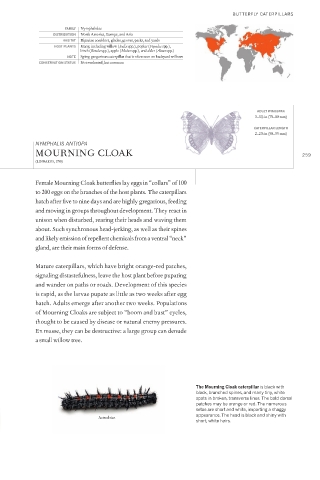
                                                                The Mourning Cloak caterpillar is black with
                                                                black, branched spines, and many tiny, white
                                                                spots in broken, transverse lines. The bold dorsal
                                                                patches may be orange or red. The numerous
                                                                setae are short and white, imparting a shaggy
                                                                appearance. The head is black and shiny with
                                Actual size
                                                                short, white hairs.

