


Page 315 - The Book of Caterpillars: A Life-Size Guide to Six Hundred Species From Around the World
P. 315
MOTH CATERPILLARS

                      FAMILY  Zygaenidae
                  DISTRIBUTION  Southern Europe
                     HABITAT  Dry, south-facing slopes with meadow and scree,
                           up to 6,600 ft (2,000 m) elevation
                  HOST PLANTS  Dock (Rumex spp., especially Rumex scutatus)
                      NOTE  Sluglike, hairy caterpillar that is found on alpine meadows
             CONSERVATION STATUS  Not evaluated, but is at risk in parts of its range


                                                                                   ADULT WINGSPAN
                                                                                  ¾–1 ⁄   in (20–30 mm)
                                                                                  CATERPILLAR LENGTH
                                                                                    ¾ in (20 mm)
            ADSCITA ALPINA
            ADSCITA ALPINA                                                                       313

            (ALBERTI, 1937)


            Adscita alpina caterpillars hatch in summer or early fall from
            oval-shaped eggs laid on the underside of leaves of various
            dock species; the eggs, at  rst pale yellow, turn blue green in

            color just before the larvae emerge. The young caterpillars mine
            the leaves, while the older ones feed on the outside of the
            leaf. The caterpillars then overwinter on or near the ground and
            become active again the following spring. They pupate on or
            near the host plant, in a loose cocoon of white silk thread. There
            is a single generation annually.


            The eye-catching, metallic blue-green adults are on the wing
            over summer, usually from June to August, but they may be
            seen as late as September. They can often be spotted feeding
            on the flowers of thistles. The species is under threat from
            agricultural intensi cation, tourist development, and the lack

            of traditional management of its meadow habitat, particularly
            scrub management, which has led to trees and shrubs colonizing
            the meadows upon which Adscita alpina relies.


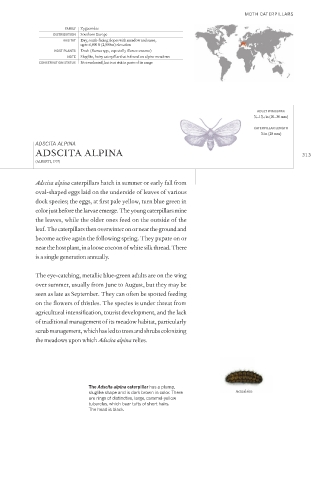
                             The Adscita alpina caterpillar has a plump,
                             sluglike shape and is dark brown in color. There   Actual size
                             are rings of distinctive, large, caramel-yellow
                             tubercles, which bear tufts of short hairs.
                             The head is black.

