


Page 317 - The Book of Caterpillars: A Life-Size Guide to Six Hundred Species From Around the World
P. 317
MOTH CATERPILLARS

                      FAMILY  Zygaenidae
                  DISTRIBUTION  Southern India and Sri Lanka, Southeast Asia, and southern China
                     HABITAT  Tropical rain forests and humid deciduous forests to 3,300 ft
                           (1,000	m) elevation
                  HOST PLANTS  Aporusa dioica and Dipterocarpus tuberculatus
                      NOTE  Caterpillar with candy-like appearance that creates its own poison
             CONSERVATION STATUS  Not evaluated


                                                                                   ADULT WINGSPAN
                                                                                  2⅜–2¾ in (60–70 mm)
                                                                                  CATERPILLAR LENGTH
                                                                                    1 ⁄   in (30 mm)
            CYCLOSIA PAPILIONARIS
            DRURY’S JEWEL                                                                        315

            (DRURY, 1773)


            The Drury’s Jewel caterpillar is brightly colored, the yellow
            and red warning colors alerting predators to its toxic nature.
            As they develop, the larvae feed on the leaves of tall, high-
            altitude, tropical trees in primary and secondary forest, and then
            pupate in a cocoon attached to the upper surface of a leaf. When
            alarmed, the caterpillar exudes droplets of cyanide from the tip
            of each of its tubercles. The caterpillars make the cyanide within
            their body, unlike many other distasteful species that acquire the
            poison from their food plant. However, the toxin is no protection
            against frequent paratisitism by nematode worms—often tiny
            juveniles that larvae accidentally ingest.


            The caterpillar passes its toxin to the adult, a brightly colored,

            day- ying moth, which is also poisonous. It is related to the

            burnet moths, also of the Zygaenidae family, but has a butter y-
            like appearance, reflected in its species name—papilionaris.
            The genus Cyclosia comprises 100 or so species. There are eight
            subspecies of the Drury’s Jewel found across Southeast Asia.


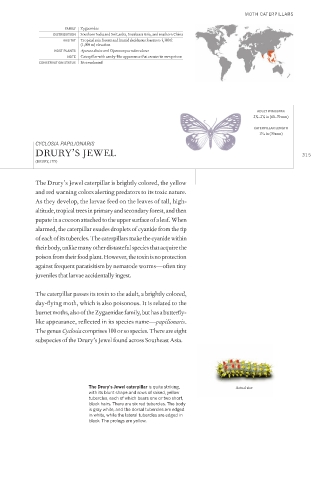
                             The Drury’s Jewel caterpillar is quite striking,   Actual size
                             with its blunt shape and rows of raised, yellow
                             tubercles, each of which bears one or two short,
                             black hairs. There are six red tubercles. The body
                             is gray white, and the dorsal tubercles are edged
                             in white, while the lateral tubercles are edged in
                             black. The prolegs are yellow.

