


Page 316 - The Book of Caterpillars: A Life-Size Guide to Six Hundred Species From Around the World
P. 316
MOTH CATERPILLARS

                                                     FAMILY  Zygaenidae
                                                 DISTRIBUTION  The Himalayas, northern India, southern China,
                                                          and Southeast Asia
                                                    HABITAT  Shaded understory of elevated forests
                                                  HOST PLANTS  Aporosa spp.

                                                      NOTE  Caterpillar that mimics particular butter y larvae
                                             CONSERVATION STATUS  Not evaluated, but not uncommon


            ADULT WINGSPAN
           2⅜–2¾ in (60–70 mm)
           CATERPILLAR LENGTH
             1 ⁄   in (30 mm)
                                                                             CYCLOSIA MIDAMA
                                                            CYCLOSIA MIDAMA
    314
                                                                             (HERRICH-SCHÄFFER, 1853)


                                            Cyclosia midama caterpillars hatch from eggs laid individually,
                                            usually on twigs and branches of the host plant or adjoining
                                            vegetation, and tend to position themselves on the underside of
                                            leaves during development. When under threat, they produce
                                            distasteful cyanoglucosides, expressed in a halo of clear droplets,
                                            from the tips of their body tubercles; if not dislodged from the
                                            secretory pore, these can be reabsorbed once the threat has
                                            passed. Associated spines are also urticating on contact. There
                                            are two generations during the summer months; the caterpillars
                                            feed in June and July, and in October and November.


                                            It has been proposed that both the caterpillars and adults of

                                            Cyclosia midama mimic separate species of butter ies (Troidini
                                            papilionid swallowtail larvae and Euploea mulciber adults). All
                                            are unpalatable at every life stage, so this would be a case of
                                            Müllerian mimicry (where different species develop similar
                                            characteristics as a protective measure). At least seven subspecies
                                            are described, but obvious differences in size, wing shape,
                                            markings, and adult genitalia may indicate there is actually more
                                            than one species involved.


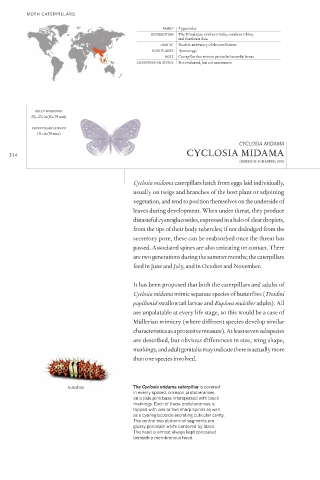
                       Actual size          The Cyclosia midama caterpillar is covered
                                            in evenly spaced, crimson protuberances
                                            on a pale pink base interspersed with black
                                            markings. Each of these protuberances is
                                            topped with one or two sharp spines as well
                                            as a cyanoglucoside-secreting cuticular cavity.
                                            The central two abdominal segments are
                                            glossy porcelain white bordered by black.
                                            The head is almost always kept concealed
                                            beneath a membranous hood.

