


Page 318 - The Book of Caterpillars: A Life-Size Guide to Six Hundred Species From Around the World
P. 318
MOTH CATERPILLARS

                                                     FAMILY  Zygaenidae
                                                 DISTRIBUTION  Northeast India, Indochina, southern China,
                                                          Chinese Taipei, and Japan
                                                    HABITAT  Forested mountain slopes and valleys
                                                  HOST PLANTS  Helicia spp., Buddleja spp., Co  ea spp., Hibiscus spp.,
                                                          and tallow (Triadica spp.)
                                                      NOTE  Caterpillar that advertises its noxiousness with classic
                                                          aposematic colors
                                             CONSERVATION STATUS  Not evaluated, but not uncommon


            ADULT WINGSPAN
           2¾–3⅛ in (70–80 mm)
           CATERPILLAR LENGTH
           1 ⁄  –1⅜ in (30–35 mm)


                                                                           ERASMIA PULCHELLA
                                                         ERASMIA PULCHELLA
    316
                                                                                      HOPE, 1841


                                            Erasmia pulchella caterpillars are not cryptic and make no e ort
                                            to conceal themselves from potential threats while feeding on the
                                            topsides of leaves. Their defensive strategy is one of aposematic
                                            red and yellow warning coloration, distasteful cyanogenic body
                                            secretions, urticating hairs and spines, and ambiguous head
                                            and tail anatomy. The main natural threat they face is from
                                            parasitoids, particularly braconid wasps, against which they
                                            have no defenses. The speci c parasitoids of the Chalcosiine

                                            subfamily to which E. pulchella belongs have been able to adapt
                                            to detoxify hydrocyanic acids, thus bypassing the group’s main
                                            defensive mechanism.


                                            Pupation occurs beneath a parchment-like silken sheet formed
                                            over a concavity on the host plant leaf or adjoining vegetation or
                                            in leaf litter. Adult moths are stunningly colored and iridescent
                                            and highly prized in collections. They fly over the summer
                                            months and inherit their distastefulness from the larval stage.
                                            In the adult, this is expressed as a toxic froth, which bubbles from
                                            thoracic glands when the moths are threatened.
                       Actual size


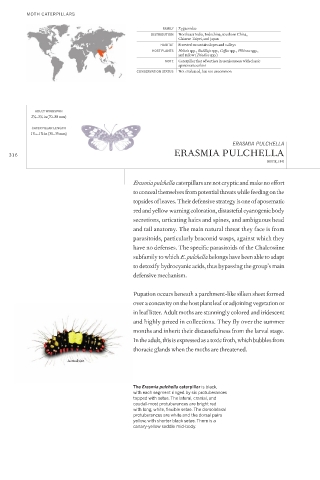
                                            The Erasmia pulchella caterpillar is black,
                                            with each segment ringed by six protuberances
                                            topped with setae. The lateral, cranial, and
                                            caudal-most protuberances are bright red
                                            with long, white,   exible setae. The dorsolateral
                                            protuberances are white and the dorsal pairs
                                            yellow, with shorter black setae. There is a
                                            canary-yellow saddle mid-body.

