


Page 319 - The Book of Caterpillars: A Life-Size Guide to Six Hundred Species From Around the World
P. 319
MOTH CATERPILLARS

                      FAMILY  Zygaenidae
                  DISTRIBUTION  Sri Lanka, southern India, northeast India and the Himalayas,
                           Thailand, Myanmar, Indochina, China, Chinese Taipei, and Japan
                     HABITAT  Montane forests
                  HOST PLANTS  Many, including tea (Camellia spp.), Aporosa spp.,
                           wild peony (Melastoma spp.), Eurya spp., Buddleja spp.,
                           and Rhododendron spp.
                      NOTE  Caterpillar that is sluglike and a noted pest of tea
             CONSERVATION STATUS  Not evaluated, but generally very common, although some
                           Japanese subspecies are speci c to individual islands and locations


                                                                                   ADULT WINGSPAN
                                                                                  2⅜–2¾ in (60–70 mm)
                                                                                  CATERPILLAR LENGTH
                                                                                    1 ⁄   in (30 mm)
            ETERUSIA AEDEA
            ETERUSIA AEDEA                                                                       317

            (LINNAEUS, 1763)


            Eterusia aedea caterpillars, also known as red slug caterpillars,
            hatch from up to 300 ovoid, yellow eggs laid by the female
            moth in stacked batches. New hatchlings are gregarious and
            graze the leaf surface but later disperse, preferring to feed on
            mature foliage. When threatened, like related moth larvae
            of the Chalcosiinae subfamily, E. aedea larvae secrete droplets of


            distasteful cyanic  uid from their many tubercles. There are  ve
            larval instars over three to four weeks. Pupation, lasting three to
            four weeks, occurs on the midrib of the topside of leaves with the
            leaf folded over the silken cocoon. In populations associated with
            tea plantations in temperate China, there are two generations
            annually—June to August and October to November. The
            second generation overwinters as a pupa.

            Eterusia aedea is easily the most widely distributed Asian species
            of the Chalcosiinae subfamily. It includes 13 subspecies (eight
            from the islands of Japan) with varied wing markings and colors,
            sizes, flight times, life histories, and host plant preferences.
            Several subspecies have been reported as pests of tea plantations,
            which means their life cycles are generally better known.         Actual size


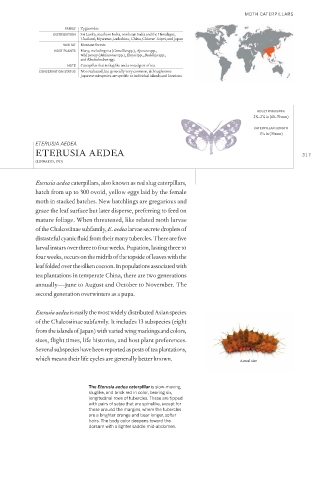
                             The Eterusia aedea caterpillar is slow-moving,
                             sluglike, and brick red in color, bearing six,
                             longitudinal rows of tubercles. These are tipped
                             with pairs of setae that are spinelike, except for
                             those around the margins, where the tubercles
                             are a brighter orange and bear longer, softer
                             hairs. The body color deepens toward the
                             dorsum with a lighter saddle mid-abdomen.

