


Page 320 - The Book of Caterpillars: A Life-Size Guide to Six Hundred Species From Around the World
P. 320
MOTH CATERPILLARS

                                                     FAMILY  Zygaenidae
                                                 DISTRIBUTION  Southeastern United States
                                                    HABITAT  Forests, forest edges, and disturbed habitats
                                                  HOST PLANTS  Carolina Laurelcherry (Prunus caroliniana)
                                                      NOTE  Toxic, sluglike caterpillar that defoliates its hosts
                                             CONSERVATION STATUS  Not evaluated, but common


            ADULT WINGSPAN
            ⁄  –  ⁄   in (15–21 mm)
           CATERPILLAR LENGTH
             ½ in (13 mm)
                                                                        NEOPROCRIS FLORIDANA
                                          LAURELCHERRY SMOKY MOTH
    318
                                                                                    TARMANN, 1984


                                            Laurelcherry Smoky Moth caterpillars feed on the underside
                                            of leaves. As young caterpillars they are found in groups,
                                            as eggs are laid in clusters. Later they disperse to feed alone
                                            or in pairs. There are usually numerous larvae on each plant,
                                            so the plants’ tough leaves are often completely skeletonized.
                      Actual size
                                            When that happens, the caterpillars suspend themselves on silk
                                            threads to  nd a new host plant. The larvae behave similarly if


                                            disturbed, so dropping o  the host plant appears also to be a
                                            defense against predators. Larger caterpillars are aposematically
                                            colored, probably indicating their toxicity, as they feed on
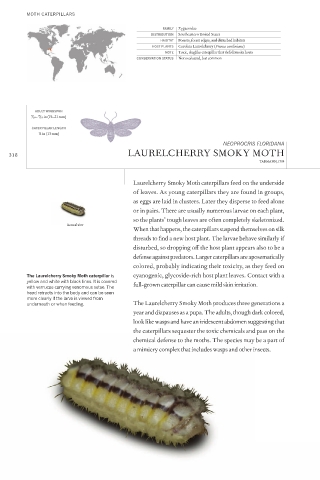
          The Laurelcherry Smoky Moth caterpillar is   cyanogenic, glycoside-rich host plant leaves. Contact with a
          yellow and white with black lines. It is covered   full-grown caterpillar can cause mild skin irritation.
          with verrucae carrying venomous setae. The
          head retracts into the body and can be seen
          more clearly if the larva is viewed from
          underneath or when feeding.       The Laurelcherry Smoky Moth produces three generations a
                                            year and diapauses as a pupa. The adults, though dark colored,
                                            look like wasps and have an iridescent abdomen suggesting that
                                            the caterpillars sequester the toxic chemicals and pass on the
                                            chemical defense to the moths. The species may be a part of
                                            a mimicry complex that includes wasps and other insects.

