


Page 321 - The Book of Caterpillars: A Life-Size Guide to Six Hundred Species From Around the World
P. 321
MOTH CATERPILLARS

                      FAMILY  Zygaenidae
                  DISTRIBUTION  Japan, Korean peninsula, Chinese Taipei, and southern China
                           (Hong Kong)
                     HABITAT  Low to medium-altitude forests
                  HOST PLANTS  Eurya japonica and E. emarginata, and Euonymus japonicus
                      NOTE  Noxious yellow-and-black caterpillar
             CONSERVATION STATUS  Not evaluated, but very common


                                                                                   ADULT WINGSPAN
                                                                                  1¾–2⅜ in (45–60 mm)
                                                                                  CATERPILLAR LENGTH
                                                                                  1–1 ⁄   in (25–27 mm)
            PIDORUS ATRATUS
            PIDORUS ATRATUS                                                                      319

            BUTLER, 1877


            Pidorus atratus caterpillars hatch from eggs laid on the host

            plant in bark crevices or developing  ower buds. As a result, the
            larvae are evenly distributed over the food plant rather than on
            isolated leaves and often in large numbers. When disturbed, the
            caterpillars produce and secrete droplets of cyanide compounds
            (mainly linamarin and lotaustralin), which is typical of the     Actual size
            Chalcosiinae subfamily of moths. This acts as a taste deterrent
            against natural predators. Contact with human skin can also

            cause a delayed urticating e ect due to breakaway fragments of

            irritating hairs. With the larva’s head disguised beneath a  eshy


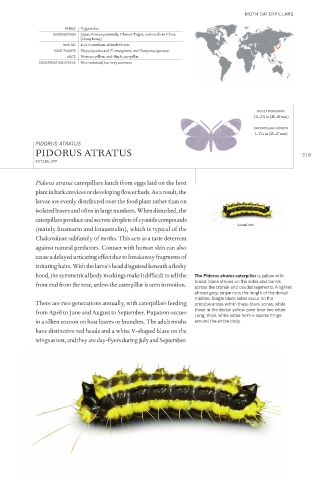
            hood, the symmetrical body markings make it di cult to tell the   The Pidorus atratus caterpillar is yellow with
            front end from the rear, unless the caterpillar is seen in motion.  broad, black stripes on the sides and bands
                                                               across the cranial and caudal segments. A lighter,
                                                               almost gray, stripe runs the length of the dorsal
                                                               midline. Single black setae occur on the
            There are two generations annually, with caterpillars feeding   protuberances within these black zones, while
            from April to June and August to September. Pupation occurs   those in the dorsal yellow zone bear two setae.
                                                               Long, thick, white setae form a sparse fringe
            in a silken cocoon on host leaves or branches. The adult moths   around the entire body.
            have distinctive red heads and a white V-shaped blaze on the
            wings at rest, and they are day- yers during July and September.

