


Page 327 - The Book of Caterpillars: A Life-Size Guide to Six Hundred Species From Around the World
P. 327
MOTH CATERPILLARS

                      FAMILY  Thyrididae
                  DISTRIBUTION  Across central and southern Europe, into Russia as far as the Urals
                     HABITAT  Woodland margins, scrub, grassy slopes, verges, and gardens
                  HOST PLANTS  Burdock (Arctium spp.), Old Man’s Beard (Clematis vitalba),
                           and Elder (Sambucus nigra)
                      NOTE  Plump, orange caterpillar that builds a distinctive leaf shelter
             CONSERVATION STATUS  Not evaluated, but locally endangered


                                                                                   ADULT WINGSPAN
                                                                                   ⁄  –¾ in (15–20 mm)
                                                                                  CATERPILLAR LENGTH
                                                                                  ⅜–½ in (10–12 mm)
            THYRIS FENESTRELLA
            PYGMY                                                                                325

            (SCOPOLI, 1763)


            The caterpillars of the Pygmy moth hatch from brown eggs
            laid up to 80 at a time, widely spaced on leaves. The larvae lead
            solitary lives, each one building a leaf shelter by rolling the leaf
            tip and securing it with silk. A new shelter is built after each molt,
            each shelter getting bigger, until, eventually, a whole leaf is used.
            The caterpillar hides in its shelter during the day and emerges
            at night to feed. It crawls to the ground to pupate, spinning a
            cocoon among dead leaves. The pupa is red brown in color.


            The day- ying moths are on the wing from May to August, and

            there are two generations. The pupae of the second generation
            overwinter. Thyris fenestrella is endangered in parts of its range
            due to the clearance of scrub and verges favored by its host
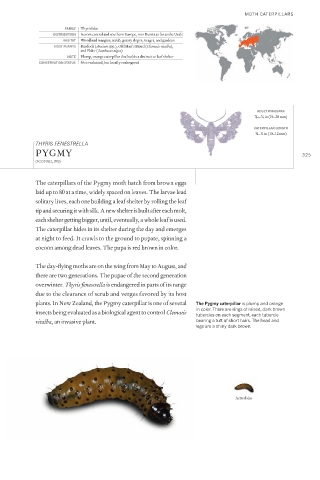
            plants. In New Zealand, the Pygmy caterpillar is one of several   The Pygmy caterpillar is plump and orange
            insects being evaluated as a biological agent to control Clematis   in color. There are rings of raised, dark brown
                                                                tubercles on each segment, each tubercle
            vitalba, an invasive plant.                         bearing a tuft of short hairs. The head and
                                                                legs are a shiny dark brown.


                                                                            Actual size

