


Page 329 - The Book of Caterpillars: A Life-Size Guide to Six Hundred Species From Around the World
P. 329
MOTH CATERPILLARS

                      FAMILY  Crambidae
                  DISTRIBUTION  Southern United States, Central America, and the Caribbean
                     HABITAT  Various habitats, in close association with host plants
                  HOST PLANTS  Coral trees (Erythrina spp.)
                      NOTE  Caterpillar that folds leaves to create a shelter
             CONSERVATION STATUS  Not evaluated, but not common, though not
                           considered endangered


                                                                                   ADULT WINGSPAN
                                                                                       –1     in (24–30 mm)
                                                                                  CATERPILLAR LENGTH
                                                                                  1     –1     in (30–40 mm)
            AGATHODES MONSTRALIS
            ERYTHRINA LEAF-ROLLER                                                                327

            GUENÉE, 1854


            The Erythrina Leaf-roller caterpillar is so-called because it
            makes shelters from a single leaf, where it remains when not

            feeding. In spring, the larvae prefer  owers, while summer and
            fall generations feed on leaves and develop more slowly than the   Actual size
            earlier generation. In north Florida, where the host plants freeze
            to the ground in November and December, resprouting from the
            roots in April, diapause occurs in a prepupal stage inside cocoons
            made of a double layer of silk. In the warmer parts of the moth’s
            range, there may be no diapause. There are four generations of
            Agathodes monstralis between May and September in Florida,
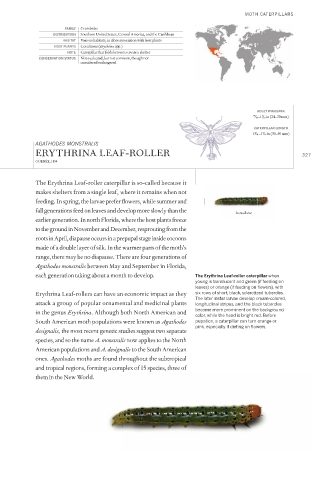
            each generation taking about a month to develop.   The Erythrina Leaf-roller caterpillar when
                                                               young is translucent and green (if feeding on
                                                               leaves) or orange (if feeding on   owers), with
            Erythrina Leaf-rollers can have an economic impact as they   six rows of short, black, sclerotized tubercles.
            attack a group of popular ornamental and medicinal plants   The later instar larvae develop cream-colored,
                                                               longitudinal stripes, and the black tubercles
            in the genus Erythrina. Although both North American and   become more prominent on the background
                                                               color, while the head is bright red. Before
            South American moth populations were known as Agathodes   pupation, a caterpillar can turn orange or
            designalis, the most recent genetic studies suggest two separate   pink, especially if dieting on   owers.
            species, and so the name A. monstralis now applies to the North
            American populations and A. designalis to the South American
            ones. Agathodes moths are found throughout the subtropical
            and tropical regions, forming a complex of 15 species, three of
            them in the New World.

