


Page 331 - The Book of Caterpillars: A Life-Size Guide to Six Hundred Species From Around the World
P. 331
MOTH CATERPILLARS

                      FAMILY  Crambidae
                  DIS TRIBUTION  Europe, North Africa, and the Middle East to western China
                  DISTRIBUTION
                  DISTRIBUTION
                     HABITAT T  Woodlands, parks, grasslands, and heaths
                        A
                     HABITAT
                     HABIT
                  HOST PLANTS S  Mosses, particularly Hypnum spp.
                    T PLANT
                  HOST PLANTS
                  HOS
                      NOTE
                      NOTE
                      NO TE  Small caterpillar that feeds and pupates on moss
                       TUS
                      T
                       A
                   TION S
                  A
             CONSERVATION STATUS  Not evaluated, but quite common
             CONSERV
             CONSERVATION STATUS
                                                                                   ADULT WINGSPAN
                                                                                  ⅝–¾ in (16–19 mm)
                                                                                  CATERPILLAR LENGTH
                                                                                   ¼–⅜ in (7–10 mm)
            EUDONIA MERCURELLA
            EUDONIA MERCURELLA                                                                   329
            (LINNAEUS, 1758)
            The female Eudonia mercurella moths lay their eggs on the
            various mosses that are host plants for the caterpillars when
            they hatch. Such mosses may be growing on tree trunks,
            rocks, walls, and other structures. The young larvae feed and
            then overwinter, becoming active and feeding again in spring.
            As they feed, the caterpillars spin a silken tube through the moss   Actual size
            and later pupate in a silken cocoon within the moss, usually
            during May and June. There is a single generation, with the
            adult moths  ying at night from June to September.


            The large and widespread Eudonia genus includes around 250
            species of micro moths, most of whose larvae feed on moss.
            The moths are often referred to as grass moths because of their
            habit of resting on grass stems during the day. At night they are


            commonly attracted to lights. Identi cation is di cult as there
            are few distinguishing features.


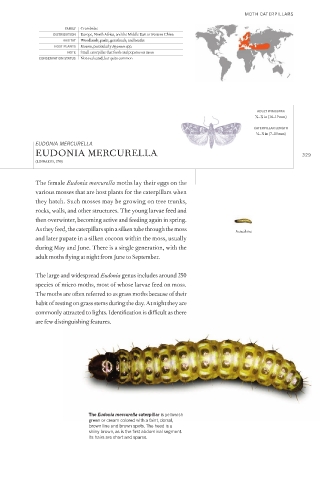
                             The Eudonia mercurella caterpillar is yellowish
                             green or cream colored with a faint, dorsal,
                             brown line and brown spots. The head is a
                             shiny brown, as is the   rst abdominal segment.
                             Its hairs are short and sparse.

