


Page 323 - The Book of Caterpillars: A Life-Size Guide to Six Hundred Species From Around the World
P. 323
MOTH CATERPILLARS

                      FAMILY  Zygaenidae
                  DISTRIBUTION  Across southern Europe into the Balkans, southern Russia,
                           and the Caucasus, Turkey, North Africa, and the Middle East
                     HABITAT  Dry, scrubby woodlands, grassy slopes, verges, and gardens
                  HOST PLANTS  Vines such as Vitis spp. and Parthenocissus spp.
                      NOTE  Caterpillar that has been a vineyard pest since ancient times
             CONSERVATION STATUS  Not evaluated


                                                                                   ADULT WINGSPAN
                                                                                   ¾–1 in (20–25 mm)
                                                                                  CATERPILLAR LENGTH
                                                                                   ¾–1 in (20–25 mm)
            THERESIMIMA AMPELLOPHAGA
            VINE BUD MOTH                                                                        321

            (BAYLE-BARELLE, 1808)


            The female Vine Bud Moth lays clusters of creamy-white eggs
            on the underside of leaves. The caterpillars feed on vine leaves,
            and their dark brown color has given the moth its alternative
            name of Dark Brown Vine Moth. The mature caterpillar spins
            a loose cocoon attached to the underside of leaves in which it
            overwinters. The pupa is light brown in color.

            The Vine Bud Moth is on the wing during the day, showing

            o  its distinctive metallic blue body and brown wings. Across
            much of its range, the moth  ies from May to July with a single

            generation, but in the south there is a second generation from
            the end of July to September. Theresimima ampellophaga is an
            important pest of vineyards, recognized as such since Roman
            times, as it damages the leaves of the grapevines and reduces
            yields. The species can be controlled by the use of pheromone
            traps that attract the males, and the use of these traps has shown
            that the moth is more widely distributed than was once thought.


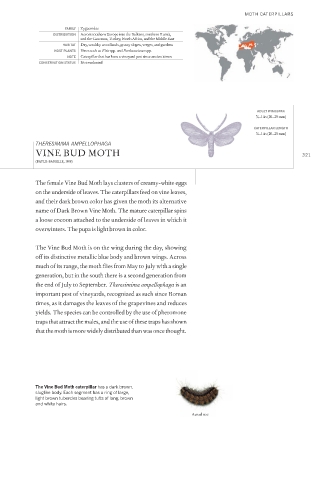
            The Vine Bud Moth caterpillar has a dark brown,
            sluglike body. Each segment has a ring of large,
            light brown tubercles bearing tufts of long, brown
            and white hairs.
                                                              Actual size

