


Page 326 - The Book of Caterpillars: A Life-Size Guide to Six Hundred Species From Around the World
P. 326
MOTH CATERPILLARS

                                                     FAMILY  Zygaenidae
                                                 DISTRIBUTION  Across Mediterranean Europe and the Balkans, into southern
                                                          Russia and the Caucasus
                                                    HABITAT  Forest margins, dry scrubby grasslands, and embankments up
                                                          to 3,950 ft (1,200 m) elevation
                                                  HOST PLANTS  Low-growing plants, including Lathyrus spp. and
                                                          vetch (Vicia spp.)
                                                      NOTE  Plump caterpillar that is seen feeding on low-growing plants
                                             CONSERVATION STATUS  Not evaluated, but some subspecies are under threat


            ADULT WINGSPAN

           1⅛–1⅜ in (28–35 mm)

           CATERPILLAR LENGTH
             1 ⁄   in (30 mm)
                                                                              ZYGAENA ROMEO
                                                            RETICENT BURNET
    324
                                                                                 (DUPONCHEL, 1835)


                                            The caterpillars of the Reticent Burnet moth hatch from oval,
                                            cream-colored eggs laid in small clusters on the underside of
                                            leaves. The larvae feed during the summer, when they are often
                                            seen basking in the sun, then overwinter and resume feeding
                                            and growing in spring. As a precaution against potentially
                                            decimating weather conditions, a few individuals will then
                                            overwinter once more to further the survival chances of the
                                            species in their locality. This strategy is also believed to reduce
                                            inbreeding. In late spring, the caterpillars spin a cocoon on the
                                            host plant and pupate.


                                            The striking red-spotted and black day- ying moth is on the

                                            wing in June and July with a single generation. There are a
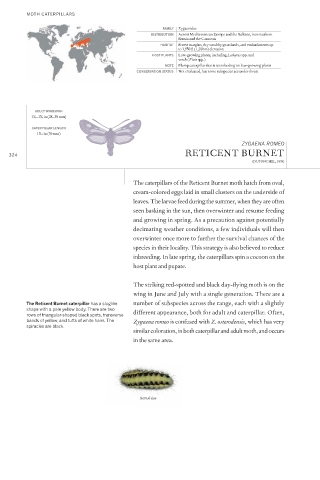
         The Reticent Burnet caterpillar has a sluglike   number of subspecies across the range, each with a slightly
         shape with a pale yellow body. There are two   different appearance, both for adult and caterpillar. Often,
         rows of triangular-shaped black spots, transverse
         bands of yellow, and tufts of white hairs. The   Zygaena romeo is confused with Z. osterodensis, which has very
         spiracles are black.
                                            similar coloration, in both caterpillar and adult moth, and occurs
                                            in the same area.


                                              Actual size

