


Page 330 - The Book of Caterpillars: A Life-Size Guide to Six Hundred Species From Around the World
P. 330
MOTH CATERPILLARS

                                                     FAMILY  Crambidae
                                                 DISTRIBUTION  Temperate and subtropical east Asia, including China, Japan,
                                                          and Korea; accidentally introduced into Germany in 2007 and
                                                          now in many other European countries
                                                    HABITAT  Scrub, woodlands, hedgerows, parks, and gardens
                                                  HOST PLANTS  Box (Buxus spp.)
                                                      NOTE  Caterpillar that in large numbers creates webbing and
                                                          extensive defoliation
                                             CONSERVATION STATUS  Not evaluated; widespread but rather local, although increasing
                                                          in Europe


            ADULT WINGSPAN
           1⅜–1 ⁄   in (35–40 mm)


           CATERPILLAR LENGTH
             1 ⁄   in (40 mm)
                                                                        CYDALIMA PERSPECTALIS
                                                                BOX TREE MOTH
    328
                                                                                    (WALKER, 1859)


                                            The Box Tree Moth caterpillar takes its common name from

                                            its host plant. Clusters of 5 to 20 eggs are laid in a  at sheet on
                                            a leaf, and the caterpillars live in groups. They create a loose,
                                            silken web with frass pellets suspended within it and graze the
                                            leaf surface, causing conspicuous pale patches of leaf death or
                                            defoliation. In addition, the larvae sometimes eat the green bark
                   Actual size
                                            of the young twigs. Pupation occurs in a cocoon between two
                                            leaves. Later broods of larvae overwinter on the food plant.


                                            The slightly iridescent, blackish and white (or almost entirely
                                            brownish black) adults fly in two to three broods, mainly in
                                            summer. In Europe, in the absence of its usual natural enemies,
                                            the species has become a pest, threatening both native and
                                            ornamental populations of box. In some places, larvae have
                                            caused repeated heavy defoliation, which, along with stripping
                                            of bark, can result in the death of the plant.


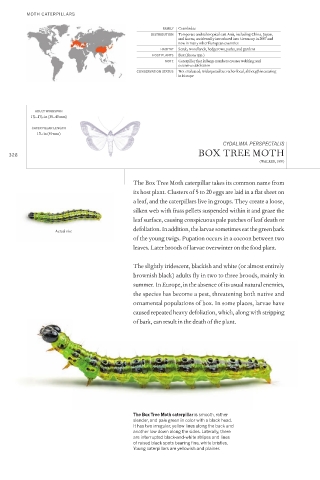
                                            The Box Tree Moth caterpillar is smooth, rather
                                            slender, and pale green in color with a black head.
                                            It has two irregular, yellow lines along the back and
                                            another low down along the sides. Laterally, there
                                            are interrupted black-and-white stripes and lines
                                            of raised black spots bearing   ne, white bristles.
                                            Young caterpillars are yellowish and plainer.

