


Page 324 - The Book of Caterpillars: A Life-Size Guide to Six Hundred Species From Around the World
P. 324
MOTH CATERPILLARS

                                                     FAMILY  Zygaenidae
                                                 DISTRIBUTION  Across Europe to western Asia
                                                    HABITAT  Woodland glades, meadows, and coastal cli s
                                                  HOST PLANTS  Legumes (Fabaceae), including Lathyrus spp., Lotus spp.,
                                                          and Trifolium spp.
                                                      NOTE  Caterpillar whose black and yellow colors warn of its toxicity
                                             CONSERVATION STATUS  Not evaluated, but common throughout its range


            ADULT WINGSPAN
           1    –1½ in (30–38 mm)
           CATERPILLAR LENGTH
            ¾–⅞ in (20–22 mm)
                                                                         ZYGAENA FILIPENDULAE
                                                              SIX-SPOT BURNET
    322
                                                                                   (LINNAEUS, 1758)


                                            The female Six-spot Burnet lays her eggs in small groups on the
                                            leaves of the host plant. The emerging caterpillars feed and then
                                            overwinter, becoming active the following spring. Occasionally
                                            they may overwinter twice. From the host plant they feed on, the
                                            caterpillars acquire cyanogenic compounds and can also create
                                            them. These compounds are protective, making the larvae,
                                            which release cyanide if attacked, highly distasteful to predators.
                                            The mature caterpillars pupate in a yellow, boat-shaped, papery
                                            cocoon attached to old grass stalks.


                                            The brightly colored, day-flying moths, which are found
                                            living in colonies, emerge and are active in midsummer.
                                            Their distinctive black forewings with red spots and crimson
                                            hindwings warn would-be predators that, like the caterpillars,
                                            they are distasteful because of the presence of cyanogenic
                                            glucosides. The chemicals are passed from the caterpillars onto
                                            the adults to give them protection; the eggs laid by the female
                                            are also laced with the toxic compounds.


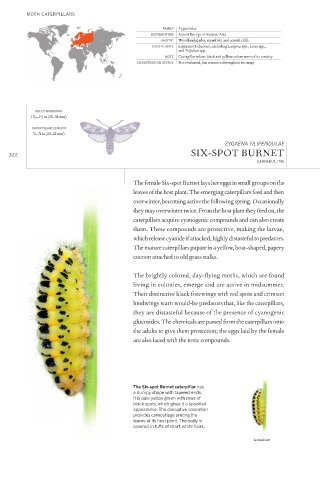
                                            The Six-spot Burnet caterpillar has
                                            a dumpy shape with tapered ends.
                                            It is pale yellow green with rows of
                                            black spots, which gives it a speckled
                                            appearance. The disruptive coloration
                                            provides camou  age among the
                                            leaves of its host plant. The body is
                                            covered in tufts of short, white hairs.

                                                                                  Actual size

